Tuesday, October 11, 2011

Kiribati seeks support for waste problem at UN Conference

11 October 2011, Changwon, Korea - Land degradation in caused by waste and pollution is an issue Kiribati hopes the 10th Conference of the Parties to the United Nations Convention to Combat Desertification will address.

A two member delegation from Kiribati is attending the UNCCD COP 10 in Changwon, Korea hoping that the outcomes of this meeting will lead to programmes of work to help Kiribati carry out national activities to address the waste and pollution issue.

L - R Mr. Puta Tofiga, Mr. Rui Tabutoa
“We already have a National Action Plan (NAP) that will focus on land degradation caused by pollution and waste on land and in water”, said Puta Tofinga the Environment Impact Assessment Officer of the Kiribati Ministry of Environment, Lands and Agricultural Development.

“Somehow we cannot really implement our actions at the national level without support and financial assistance.”

Rui Tabutoa, the Assistant Secretary of the Kiribati Ministry of Environment, Lands and Agricultural Development is hopeful the voice of Kiribati will be heard and outcomes will address their priority issue.

“Kiribati is a party to the UNCCD and it’s our obligation to comply with this convention, land degradation caused by land based pollution is a problem we hope we are closer to resolving with help from this Convention.”

The Cook Islands, Vice Chair of the Asia Pacific region at the UNCCD

10 October, Changwon, Korea - The Cook Islands has been elected as the Vice Chair for the Asia and Pacific  region at the 10th Conference of the Parties to the United Nations Convention to Combat Desertification.  The position of Chair is held by Iran.

“This was a bit unexpected,” said Louisa Karika of the Cook Islands.


Louisa Karika (Center) with delegates from Bhutan
“Our Chair was nominated however he will not be here for the full Conference so I was asked to fill in his place for next week.  In that process while getting the concensus of the group, it was amended into the Cook Islands becoming the Vice Chair for the regional Asia annex.”

The Pacific is recognised as one of the 6 sub regions under the regional annex of Asia at this UN Convention for which land degradation is a key concern for the region.  However the 10th Conference of the Parties to the UNCCD has labelled this group as the Asia and Pacific Group.

There are 14 Pacific island countries and territories that are a party to this UN Convention which was formed out of the Rio Earth Summit in 1992.

It was acknowledged that this is the first time the Pacific region has held such a position.

“Over the next two years I will be supporting the Chair when he is not available in terms of coordinating in the region, this position is more a supportive role.”

Care for Land, Land for Life

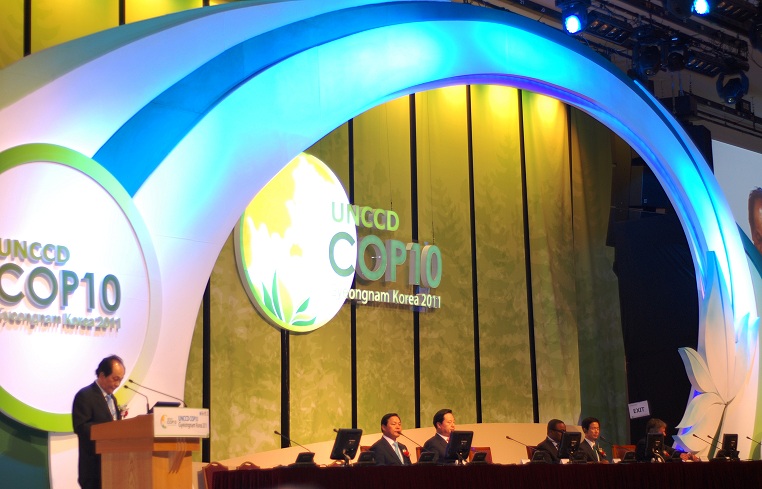
10 October 2011, Changwon, Korea - The 10th Conference of the Parties to the United Nations Convention to Combat Desertification has opened in Korea. 

14 Pacific island countries are parties to this Convention that addresses land degradation and sustainable land management, a significant issue of concern for the region.  (Visit www.bionesian.blogspot.com)

While productive land becomes scarcer, providing food for the 9 billion people predicted to live on Earth in 2050 will require a 70 per cent increase in global food production.

Over the course of the next two weeks, island nations in the Pacific are at the conference with the 180 parties to the convention to shape the way forward that will help stop land degradation in our region.

“The Earth, once a healthy planet is slowly losing its’ health and vitality,” said the Governor of the Gyeongnam Province, host to the UNCCD COP 10.

The past President of the UNCCD COP asked that parties at these negotiations multiply forces to achieve the objectives under the convention.

Opening UNCCD COP 10 Plenary
“Dont forget the beneficiaries for whom these efforts are being deployed,” asked Jose Cueva, Director of Soil Conservancy of Argentina, before he welcomed the election of Don koo Lee, the Minister of Korea Forest Service as President of COP 10 who asked that countries be bold, ambitious and creative in talking the unresolved methodological and institutional issues.

“At the Rio Earth Summit in 1992, desertification, climate change and biodiversity loss were identified as the greatest challenges to sustainable development, now desertification, drought and land degradation remains with a low profile but these issues are equally important as others.”

The 10th Conference of the Parties to the UNCCD Opened in Changwon Korea on 10 October and will end on 21 October, 2011. 

The Secretariat of the Pacific Regional Environment Programme (SPREP) has a delegation of three to provide technical and communications support to the 14 Pacific island countries and territories at this Conference.

L - Mr. Bruce Jefferies, Mr. Tepa Suaesi
"We have provided support to the Pacific countries in the months leading up to this international event, providing both a Policy brief for guidance for the Pacific as well as staging a Pacific regional preparatory meeting," said Bruce Jefferies the Terrestrial and Ecosystems Management Officer at SPREP.

"We look forward to seeing what the coming meeting will bring for the Pacific region as we combat land degradation, a vital concern given the livelihoods of our Pacific people depends on our biodiversity and what the land can yield."

Keep reading www.bionesian.blogspot.com to keep update with the news.

Tuesday, June 21, 2011

Vanuatu Launches the Pacific Year of the Dugong Campaign

6 June 2011, Vanuatu - The Vanuatu Minister of Lands and Natural Resources, Hon. Steven Kalsakau, launched the Vanuatu Pacific Year of the Dugong campaign on Monday 6 June 2011. The launched was held at the Vanuatu Kultural Senta, and was attended by representatives from various  Government Departments and NGOs.


Honourable Minister Steven Kalsakau,
Minister of lands Geology & Mines & Natural Resources giving official speech
The launch was together with the launching of a book, “Santo 2006”, produced by Institut de recherche pour le développement (IRD) Noumea. The book entails a “ridge to reef” research project conducted on Vanuatu’s biggest island, Espiritu Santo, in 2006. The project involved many Government agencies in Vanuatu.

The Vanuatu PYOD launch was also on "World Environment Day" June 6.

The Vanuatu Department of Environment is working with the Department of Fisheries on activities, including school awareness programme, for the second half of the year. The questionnaire-based dugong survey is also being conducted through-out Vanuatu involving Peace Corp Volunteers for the outer Islands.


Minister of Lands, Geology & Mines & Natural Resources
Hon. Steven Kalsakau alongside other Dignitaries
Below is the speech made by the Vanuatu Minister of Lands and Natural Resources and Environment at the official launch

Honourable Steven Kalsakau, Minister of Lands & Natural Resources & Environment Official Speech at Official Launching of the Regional Year of The  Dugong in Vanuatu.

Time & Date: 3:30pm June 6th 2011
Venue: Vanuatu Kultural Senta (VKS)
Honorouble Prime Minister, Sato Kilman
Ministers & Members of Parliament
Heads and staff of different government departments
Members of the Diplomatic Corps
Representatives of  Non –Government Organisations
Representatives of the Vanuatu Christian Council
Representatives of  Chiefs
Invited Guests
Ladies & Gentlemen

I am very happy to accept this invitation, to be able to be part of this ceremony this afternoon, to officiate this special event. I would like to take this opportunity as the minister responsible for the environment in Vanuatu. To say thank you to the Department of Environmental Protection & Conservation and the Department of Fisheries of the Government of Vanuatu. For inviting me to give the official speech for the launching of the “Regional Year of the Dugong.”

Today we also commemorate “World Environment Day” which is always held on the 5th of June of Every Year. The main theme of this years’ world environment day is;

‘Forests: Nature at Your Service’

This World Environment Day theme also supports the 2011 UN International Year of the Forests.

At the Regional level, the Secretariat of the Pacific Regional Environment Programme (SPREP) has declared that 2011 be the ‘Regional Year of the Dugong’. The theme to celebrate this regional year of the dugong is

‘Respect and Protect’

These two themes reminds us of the importance of conserving and protecting our biodiversity in our world today and even in Vanuatu.

It reminds us that we should look after and safeguard the plants and animals, the nature and wildlife that our country has to offer. As they are an integral part of our society.

With the important themes of World Environment Day and the regional year of the dugong. It is very pleasing that Vanuatu can take part in these special event like other countries in the world. These events give us a chance to reflect upon our natural environments and things within them that we depend upon for the development and support of our livelihoods.

SPREP has declared that 2011 be the ‘Regional Year of the Dugong’. Dugongs or Sea Cows are marine mammals that mainly feed on Sea Grass. In Vanuatu they are mainly found on islands that have abundant seagrass habitats. Mainly Reef islands in the Banks, East Coast of Santo, Central and South West Coasts of Malekula, North East coast of Epi, Port Havannah on Efate and South East Coast on Tanna.

Dugongs are registered under the “Convention of International Trade of Endangered Species of Wild Fauna & Flora (CITES). Vanuatu is a member of CITES when we signed the convention in 1989. CITES has a list of Endangered Plants and Animals which has strict controls of trade of these species between countries of the world. Dugongs are listed in the international list of endangered species. Which means that they cannot be captured for sale or for consumption or trade within a country or between countries.

To mark this ‘regional Year of the Dugong’ the department of Environmental Protection & Conservation along with the Fisheries Department have planned some activities to carryout throughout the remainder of the year. Activities include exhibitions, school competitions in essay writing and art work. Printing of Posters and T- shirts. School Visits and talks to students. Radio talkback shows and tv programmes. As well as Community Awareness raising about the importance of conserving Dugongs.

It is my understanding that some communities in Vanuatu maintain some Cultural or Custom Practises associated with Dugongs. In some islands dugongs are hunted and eaten according to local customs and beliefs.

I would like to ask that these communities that if they continue with these cultural practices that they bear in mind that the animal is an endangered species. And that only one animal should be killed instead of ten or twenty at one time. Advice should be sought after from the Departments of Environment and Fisheries on such matters.

This would help ensure the sustainability of healthy Dugong Populations in the country.

As the Minister responsible for the Environment I would like to encourage all departments of government to work together with the Department of Environmental Protection and Conservation and Department of Fisheries to carry out activities throughout the year to celebrate ‘Regional Year of the Dugong’. I would like to ask everyone involved to implement sound activities to raise awareness to our people around Vanuatu, especially our school children, So that they may learn more about Dugongs and help protect them so that they will always remain in our waters.

I would like to ask all communities around Vanuatu to work together with the departments of government to implement awareness raising activities within our different islands.

It is our duty, as citizens of our country to look after our lives and our environment. Because our environments also sustains our lives and provides for our livelihoods.
We must respect & Protect our plants and animals, especially endangered species such as the Dugong.

With this Speech, I as the Minister responsible for the Environment, have the great honour now to declare ‘ Regional Year of the Dugong’ Officially open this year 2011. And I would like to wish all departments responsible and all communities around Vanuatu a great celebration of the events to commemorate this year 2011as the ‘Regional Year of the Dugong’


Shangri-La's Fijian Resort and Spa Celebrates World Ocean Day

14 June 2011, Release from Shangri-La's Fijian Resort and Spa - Shangri-La’s Fijian Resort & Spa staff and volunteers from the Cuvu District School Environment Club potted and planted more than 300 mangrove seedlings and made two fish houses to mark World Ocean Day that was celebrated globally on Wednesday 8th June. (Right - Marine Manager Mereoni Mataika with students from Cuvu District School Environment Club with one of the nurseries planted.)


Twenty eight students from the Cuvu Environment club were split into two groups to take part in the fun filled activities led by Marine Manager, Ms. Mereoni Mataika.  The event was held over three hours with mini quizzes which saw each student going home with a prize, mangrove potting along the Yanuca eastern coast and fish house building. To end the day, the children were hosted to refreshments provided by the Resort and a prize giving ceremony for quiz winners.  (Left - Volunteer Mosese Navaci with students from Cuvu District School Environment Club after making fish houses.)


“Our partnership with the Cuvu District School Environment Club is a critical one as these young people aged between 10-13 years will become future leaders in our community and in Fiji,” said Resort general manager, Michael Monks. “We will continue to support and raise awareness of the importance of looking after our environment and we will continue to encourage ongoing partnerships with our communities,” Mr Monks said.  (Right - General Manager Michael Monks presenting prizes to quiz winners)


Shangri-La Hotels and Resorts remain committed to operating in an economically, socially and environmentally responsible manner while balancing the interests of diverse stakeholders.  In striving to be a leader in corporate citizenship and sustainable development, a corporate-level CSR Committee drives the company’s initiatives in the strategic areas of stakeholder relations, environment, health and safety, supply chain and employees.  Under the umbrella of SUSTAINability, Shangri-La’s social responsibility program consists of the two elements of “embrace” and “sanctuary.”  Embrace focuses on Shangri-La’s Caring People Project, which aims to promote the highest level of education and health support in underprivileged communities.  In sanctuary, the program concentrates on Shangri-La’s Care for Nature Project, which promotes the conservation and restoration of biodiversity.  For more information, please access the CSR section on www.shangri-la.com.                  
  
Staff and management with students from the Cuvu District School Environment Club
following World Ocean Day activities
.

Students from Cuvu District school Environment Club
inside the Shangri-La's Marine Education Centre dead zone exhibit.


PRESS CONTACT:               Lata Yaqona
Communications Manager
Shangri-La’s Fijian Resort & Spa                             
Tel: (679) 652 8708
Fax: (679) 652 0931                           
E-mail: lata.yaqona@shangri-la.com
Website: www.shangri-la.com           

For digitised pictures of the group’s hotels, please go to http://www.shangri-la.com/imagelibrary

Wednesday, May 18, 2011

Conservation awareness strengthened in Rotuma


Bridge at Ka'ta - Rotuma.  Photo by Alan Howard

19 May, Nadi, Fiji - Empowered communities in Rotuma, an isolated island located to the North of Fiji, are strong stewards of their environment caring for their biodiversity and undertaking programs to conserve nature on the island.

The LäjeRotuma Initiative (LRI) is a community-based environmental education and awareness development programme in Rotuma that has provided strong support to the local communities.  Formed in 2002 by a group of young Rotumans, to bridge their home island with the rest of the world in raising awareness on environment issues, the LRI has successfully led numerous activities on the island.

Rotuma is a 43 square kilometer Island with a population density of 61 people per square km (Fiji Census 1996). It is situated in the South West Pacific, about 465km North of Fiji.
Rotuma‚ as a geographical isolate, with an economy that is externally influenced from mainland Fiji, illustrates the high dependence of an island community on its natural resources.
The Eco-camp facilitated by the LRI, held in the Yasawa Islands, 2009.  Image courtesy of the LRI
“LRI has, over the years grown from humble beginnings to being recognised as an important partner that decision making processes affecting Rotuma’s development and natural resource use plans,” said Alfredo Ralifo of WWF, one of the founding members of the LäjeRotuma Initiative.
“Currently, LRI is in the process of registering itself as a charitable trust so that it can be more effective in achieving its vision for Rotuma and her people.”
When it began the LäjeRotuma Initiative focused on engaging youth to strengthen the capacity of the island community in making informed decisions on managing the natural resources of Rotuma.  LRI has now grown to include nature conservation activities on the island. 
The range of these activities includes carrying out baseline biodiversity surveys in Rotuma, 10 island youth trained as certified PADI Open Water divers to help conduct basic scientific coral reef surveys in Rotuma, funding secured to help implement community conservation awareness and many other achievements.
One of the most recent involves assisting the Yasawa Island Group in Fiji with forming a Biodiversity Conservation Network named Tikina Naviti Conservation Initiative.
The Eco-camp facilitated by the LRI, held in the Yasawa Islands, 2009.  Image courtesy of the LRI
“Sharing lessons between two unique but similar island communities to support each other in terms of protecting their unique island biodiversity is very important. The LäjeRotuma Initiative hopes to share its lessons and experiences over the years with other island communities and establish a network of island communities to improve community livelihoods and as well as building resilience towards the effects of Climate Change.”
The current Plan of Action for the LRI encompasses community outreach, building community resilience to climate change, integrated fisheries management, sustainable livelihoods options and research and capacity building.
For more information on the LäjeRotuma Initiative  and to make contributions, please visit: http://www.rotuma.net/os/lajerotuma.htm

The Secretariat of the Pacific Regional Environment Programme (SPREP) is a major partner of the LRI, other major partners are: Rotuma Island Council, Rotuman Member of Parliament,  WWF, AUSAID, Marine Studies Program, Institute of Marine Resources, SISA, University of  the South Pacific, GCRMN, Global GreenGrants Fund, British High Commission Suva,  SeaWeb, Coral Cay Conservation, PADI Foundation, Project AWARE, Ministry of  Youth, WAC Theatre Unlimited, Rotuman Suva-7-Districts, Rotuma website, Rotuma Island  Coordinator & Youth Volunteer Network.

Tuesday, May 17, 2011

Pacific still to sign agreement on biodiversity benefits


18 May Nadi Fiji - The Pacific island countries are yet to sign on to an international agreement that that aims at sharing the benefits that come from using genetic resources, in a fair and equitable way. 

After six years of negotiations, there is now an international agreement adopted by the international community at the 10th Conference of the Parties to the Convention on Biological Diversity in Nagoya last year. 

Participants at the Pacific biodiversity meeting in Nadi this week
The protocol is now open for signature by Parities to the Convention 60 signatories from countries are required by 1 February next year before the Protocol can come into effect, to date there are 21 countries that have signed on.

The Government of Fiji has announced they intend to sign the Protocol before February next year, with a timeline to help raise awareness and understanding of the Nagoya Protocol.

“Fiji intends to establish an interdepartmental committee to specifically undertake preparations towards the signing of the Nagoya protocol,” said Eleni Tokaduadua from the Fiji Environment Department.

“This process will involve a lot of consultations to inform all stakeholders on the various issues relating to ABS and ensure better understanding at all levels of the decision making process.”


Eleni Tokaduadua, Fiji
The international agreement guarantees balanced access to genetic resources on the basis of prior informed consent and mutually agreed terms.  The Nagoya Protocol also ensures the fair and equitable sharing of benefits while taking into account the important role of traditional knowledge. 
A hypothetical example of this is if an international pharmaceutical company discovered a native plant in Samoa which could lead to a drug that cures, then that company would now be obliged to share the profits arising with Samoa.
“Fiji is keen to see that our local communities and resource owners get a fair share of the benefits gained from the utilization of their natural resources.  Signing the protocol will allow Fiji to access resources to put in place effective and reliable mechanisms towards this.”

India is host to the eleventh international biodiversity conference in 2012, it is planned this will also convene the Nagoya Protocol’s first meeting of the Parties.

The Secretariat of the Pacific Regional Environment Programme (SPREP) will work with partners to assist them with the Nagoya Protocol.

For more information on this please visit the Convention on Biological Diversity website - http://www.cbd.int/abs/


Looking back: Pacific attendance at every International UN Biodiversity Conference


18 May 2011 Nadi, Fiji - Since the very first Conference of the Parties to the Convention on Biological Diversity (CBD COP) in 1994, the Secretariat of the Pacific Regional Environment Programme (SPREP) has consistently provided support to the Pacific island region at these negotiations.   
A brief review of Pacific attendance and performance at all CBD COP negotiations was compiled for participants at a Pacific island meeting on biodiversity in Nadi this week.   The performance of the region at the 10th International Biodiversity conference in Nagoya last year and how we move forward is the topic on the table for discussions.

Dr Jill Key (right) SPREP

“In consistently attending the international negotiations on biodiversity it shows the dedication and commitment from the Pacific region towards conserving and protecting our biodiversity,” said Dr Jill Key SPREP’s Capacity Development Adviser.
“In the Pacific it is the biodiversity that supports the livelihoods of people.  It has a lot of meaning in the region as the foundation of our culture and traditions as well as providing an economic income for a lot of Pacific families.  The Pacific is committed to the international process.”
As for the active performance of the Pacific region at the meetings, over the past decade the Pacific has made interventions during the negotiations at each CBD COP.  Last year in Nagoya the Pacific made 33 interventions on 17 different issues, and it was also the first time that an opening and closing statement was made from the Pacific negotiators on behalf of the region.

Tuvalu (left), IUCN Oceania (right) at the CBD COP 10

At the international negotiations on biodiversity, the key issues for the Pacific region have been; Protected areas with 22 statements which began with the seventh meeting in Kuala Lumpur; Invasive species was addressed through 18 different Pacific interventions that have been made since the fifth meeting in Nairobi, Kenya; Marine and coastal biodiversity is an issue for which 17 Pacific statements have been presented since the second meeting in Indonesia; and the Pacific have made 12 interventions at the international negotiations on Knowledge of indigenous communities since COP4 in 1998 hosted by Slovakia.
“It is important that the thematic topics and issues that are important to the Pacific region continue to be followed through and raised at COP meetings to emphasise their importance to our region particularly progress on actions taken to address these issues,” said SPREP’s Biodiversity Adviser, Easter Galuvao.
The next Conference of the Party to the Convention on Biological Diversity (CBD COP11) will be hosted by India in 2012.


Monday, May 16, 2011

PILN highlighted as a model for South-South Cooperation

PILN - Moorea, Tahiti - Photo by Dr Jill Key
Seven-years since the Pacific Island countries requested for its set up – the Pacific Invasives Learning Network (PILN) will be showcased at a South-South Cooperation meeting in Korea from 18-20 May.

PILN which was endorsed by the SPREP member countries at its 15th meeting held in French Polynesia, started as a two year pilot project supported by eight environment organisations providing funding support and expert advice.

PILN is a network of national and local agencies working on invasive species in 13 Pacific Island countries and territories. The agencies from different government departments, the private sector and non-governmental organisations form teams to coordinate invasive species planning and to undertake field work.

PILN exists to address important issues that characterise the Pacific island countries, such as the limited resources in terms of human capacity, skills as well as financial and geographic isolation. Professional isolation is also another factor that if not addressed can lead to invasive species workers feeling helpless.

“PILN is about training our people on skills they need to do the job. When we trained them, we want them to go back and apply their new knowledge”, says the PILN Coordinator, Dr Posa Skelton.

“We are there to encourage them to apply that knowledge and to assure them of the support from the rest of the network. The network is also there to share their achievements and to celebrate their successes”.

Today 15 PILN teams are working on priority invasive species issues on their islands. Some of these teams have developed their invasive species strategy and action plans and they are in the implementation phase.

Capacity has been built on a wide-range of issues including strategic planning, eradicating pests from islands to developing awareness information for their communities.

The Convention on Biological Diversity is holding a meeting in Incheon, Korea to share capacity building experience from around the world focussing on developing countries, or south-south cooperation.

The South-South cooperation describes how information, knowledge, technology and resources are shared amongst developing countries.

The Pacific islands have a strong history of south-south cooperation especially in the environment field, which led to the establishment of the Secretariat of the Pacific Regional Environment Programme (SPREP).

The Pacific Invasives Learning Network, which is an important component of the SPREP invasive alien species work, will seek partnership opportunities with other capacity building initiatives from around the world.

Sunday, May 15, 2011

Lessons learnt by the Pacific


16 May Nadi Fiji - In 2010 the One Pacific Voice was heard loud and clear at the International Biodiversity Conference which brought 18,000 people together to forge a path forward to help save and strengthen global biodiversity.  This week in Fiji, the Pacific region has regrouped to reflect on what was learnt while at the CBD COP 10 in Nagoya.  Day one of the meeting today, heard from five different Pacific representatives’ share their experiences with others.


“I gained personally and professionally.  Planning and prioritising on a daily basis is crucial when you attend the COP, you always need to be in good health as it’s a lengthy and can be a stressful process.  You need the energy to attend discussions during the days and nights.  It is a good experience but gruelling and you should try to be in all aspects of the COP – working groups, side events, plenary sessions and ministerial level meetings.” – Eleni Rova Tokaduadua, Fiji


“It was good to see that we had synergized issues so that what is said not only benefits your country, but the Pacific islands region as a whole.  It was also helpful that everyone shared information and resources – I was glad that we had people attending who were willing to share information with you on what happened at meetings in case you missed out so you can be kept up to date.” – Fale’afaga Tony Tipama’a, Samoa


“I think having at least one week for negotiations training would be helpful for the Pacific delegates so we can be confident and prepared at this level.  I also think we in the Solomon Islands should have a national workshop like Fiji so when we come together we can feed the results into the Pacific region.” – Joe Horokou, Solomon Islands


“I was fortunate and happy to represent my country, I learnt the value of a side event and how you can use it to raise your country profile.  We also found the half day meeting just before the COP where we learnt about the processes very helpful.  Another highlight for me was how once we had made the Pacific opening statement - it opened the door for support of our position from other regions.”  Solomona Lotoala, Tuvalu


“I recommend that you familiarize yourself with the pre-COP information, package so you are really well prepared for the COP meeting.  It’s also good if you look for the media for updates, visit the SPREP media releases and the Earth Negotiations Bulletin is also helpful to keep you updated.  There is also a wealth of information within the Pacific delegations, there are a lot of experienced people, it’s good if you can learn from them” – Joseph Brider, Cook Islands


"Talking the Biodiversity Talk":  COP = Conference of the Parties

Notes:The meeting is held from 16 – 20 May at the Tanoa Hotel in Nadi, Fiji.
Participants are from the Cook Islands, Timor Leste, Federated States of Micronesia, Fiji, Kiribati, Marshall Islands, Nauru, Niue, Palau, Samoa, Solomon Islands, Tonga, Tuvalu, Vanuatu, Foundation of the Peoples of the South Pacific International (FSPI), IUCN - International Union for Conservation of Nature, United Nations Environment Programme (UNEP), WWF South Pacific Programme, University of the South Pacific.