Showing posts with label One Pacific Voice. Show all posts

Tuesday, October 11, 2011

The Pacific featured at climate change side event in Korea

12 October, 2011, Changwon, Korea - The voice of the South Pacific was heard amongst the African concerns at the 10th Conference of the Parties to the United Nations Convention to Combat Desertification in Korea.

While 41% of the earth’s land area are drylands that house two billion people, in the Pacific region only 2% is terrestrial while 98% is ocean.  Despite this land degradation is a major concern for the Pacific region under this Convention. Without the ability to grow food, protect water sources the Pacific faces major threats ranging from loss of livelihoods ecosystems and loss of food security.

Day 3 of the two week conference focused on Ecosystem-based Approaches to Climate Change: Addressing Adaptation and Mitigation at the Rio Ecosystems Pavilion. 

The Secretariat of the Pacific Regional Environment Programme (SPREP) was one of a panel of six that presented on the Pacific environment at a special session on Dryland Protected Areas:  Ecosystem-based Approaches(EbA) to Climate Change.


Bruce Jefferies the Terrestrial Ecosystems Management Officer at SPREP provided a Pacific overview of biodiversity conservation and ecosystem based adaptation which clearly outlined that drylands are not a landmark of the Pacific, however the Pacific is utilising EbA to adapt to climate change.

“The Pacific makes up 30% of the surface area of the planet and the islands are very diverse,” said Jefferies.

“Small islands don’t have the advantages that continents have, communities can’t move to higher altitudes and they are very small so moving laterally is also unrealistic.  We’re here to provide a “Pacific Voice” at this Conference and to ensure that the Pacific is back on the global radar.”

The SPREP Conservation International (CI) partnership is working on a Ecosystem-based Adaptation Project. This aims at encouraging climate change adaptation that integrates the use of biodiversity and ecosystem services into an overall strategy that will help people adapt to the adverse impacts of climate change.

“In the Pacific mangrove protection is valued at between US200, 000.000– 900,000.00 per hectare.  Without mangroves protection the communities, would be vulnerable to storm surges and tsunamis that not only cause environment degradation, but have already caused loss of life.”

Another key point from the panel presentations was made by Ms. Kathy MacKinnon of the IUCN - World Commission on Protected Areas that are promoting Natural solutions.

“Land conversion is responsible for 20% of the greenhouse gas emissions.  If we can stop habitat loss we can reduce these emissions.  12.7% of the World’s land surfaces are Protected Areas, through protecting our biodiversity and ecosystem services and good we can help people cope with climate change, desertification, drought, and land degradation.”

Scenes of the UNCCD COP 10

Changwon, Korea, 10 - 20 October, 2011
Photos by SPREP - http://www.sprep.org/


L - R Louis Karika Cook Islands, Tepa Suaesi SPREP, Bruce Jefferies SPREP
Friendly chat before the Asia Pacific Group Meeting -
L - R Mr Tyrone Deiye Nauru, Mr Warwick Harris Marshall Islands

Delegates from Samoa L - R Ms. Fa'ainoino Laulala, Ms. Filisita Heather


Billboard outside of the Conference venue


Security checkpoint inside conference venue


L - R Madelsar from Palau with Cindy from FSM before the plenary starts


Foyer of the UNCCD COP10 during early morning hours,
this is where accreditation and registration takes place


Maria Elder, Fiji


The Cook Islands, Vice Chair of the Asia Pacific region at the UNCCD

10 October, Changwon, Korea - The Cook Islands has been elected as the Vice Chair for the Asia and Pacific  region at the 10th Conference of the Parties to the United Nations Convention to Combat Desertification.  The position of Chair is held by Iran.

“This was a bit unexpected,” said Louisa Karika of the Cook Islands.


Louisa Karika (Center) with delegates from Bhutan
“Our Chair was nominated however he will not be here for the full Conference so I was asked to fill in his place for next week.  In that process while getting the concensus of the group, it was amended into the Cook Islands becoming the Vice Chair for the regional Asia annex.”

The Pacific is recognised as one of the 6 sub regions under the regional annex of Asia at this UN Convention for which land degradation is a key concern for the region.  However the 10th Conference of the Parties to the UNCCD has labelled this group as the Asia and Pacific Group.

There are 14 Pacific island countries and territories that are a party to this UN Convention which was formed out of the Rio Earth Summit in 1992.

It was acknowledged that this is the first time the Pacific region has held such a position.

“Over the next two years I will be supporting the Chair when he is not available in terms of coordinating in the region, this position is more a supportive role.”

Care for Land, Land for Life

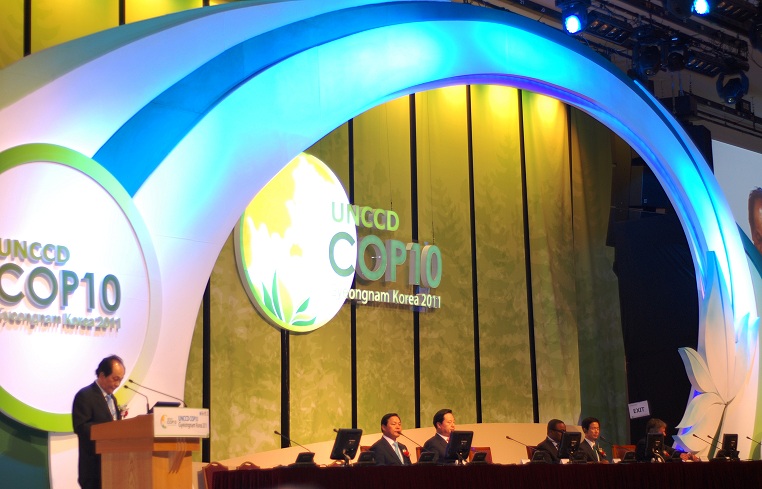
10 October 2011, Changwon, Korea - The 10th Conference of the Parties to the United Nations Convention to Combat Desertification has opened in Korea. 

14 Pacific island countries are parties to this Convention that addresses land degradation and sustainable land management, a significant issue of concern for the region.  (Visit www.bionesian.blogspot.com)

While productive land becomes scarcer, providing food for the 9 billion people predicted to live on Earth in 2050 will require a 70 per cent increase in global food production.

Over the course of the next two weeks, island nations in the Pacific are at the conference with the 180 parties to the convention to shape the way forward that will help stop land degradation in our region.

“The Earth, once a healthy planet is slowly losing its’ health and vitality,” said the Governor of the Gyeongnam Province, host to the UNCCD COP 10.

The past President of the UNCCD COP asked that parties at these negotiations multiply forces to achieve the objectives under the convention.

Opening UNCCD COP 10 Plenary
“Dont forget the beneficiaries for whom these efforts are being deployed,” asked Jose Cueva, Director of Soil Conservancy of Argentina, before he welcomed the election of Don koo Lee, the Minister of Korea Forest Service as President of COP 10 who asked that countries be bold, ambitious and creative in talking the unresolved methodological and institutional issues.

“At the Rio Earth Summit in 1992, desertification, climate change and biodiversity loss were identified as the greatest challenges to sustainable development, now desertification, drought and land degradation remains with a low profile but these issues are equally important as others.”

The 10th Conference of the Parties to the UNCCD Opened in Changwon Korea on 10 October and will end on 21 October, 2011. 

The Secretariat of the Pacific Regional Environment Programme (SPREP) has a delegation of three to provide technical and communications support to the 14 Pacific island countries and territories at this Conference.

L - Mr. Bruce Jefferies, Mr. Tepa Suaesi
"We have provided support to the Pacific countries in the months leading up to this international event, providing both a Policy brief for guidance for the Pacific as well as staging a Pacific regional preparatory meeting," said Bruce Jefferies the Terrestrial and Ecosystems Management Officer at SPREP.

"We look forward to seeing what the coming meeting will bring for the Pacific region as we combat land degradation, a vital concern given the livelihoods of our Pacific people depends on our biodiversity and what the land can yield."

Keep reading www.bionesian.blogspot.com to keep update with the news.

Sunday, May 15, 2011

Lessons learnt by the Pacific


16 May Nadi Fiji - In 2010 the One Pacific Voice was heard loud and clear at the International Biodiversity Conference which brought 18,000 people together to forge a path forward to help save and strengthen global biodiversity.  This week in Fiji, the Pacific region has regrouped to reflect on what was learnt while at the CBD COP 10 in Nagoya.  Day one of the meeting today, heard from five different Pacific representatives’ share their experiences with others.


“I gained personally and professionally.  Planning and prioritising on a daily basis is crucial when you attend the COP, you always need to be in good health as it’s a lengthy and can be a stressful process.  You need the energy to attend discussions during the days and nights.  It is a good experience but gruelling and you should try to be in all aspects of the COP – working groups, side events, plenary sessions and ministerial level meetings.” – Eleni Rova Tokaduadua, Fiji


“It was good to see that we had synergized issues so that what is said not only benefits your country, but the Pacific islands region as a whole.  It was also helpful that everyone shared information and resources – I was glad that we had people attending who were willing to share information with you on what happened at meetings in case you missed out so you can be kept up to date.” – Fale’afaga Tony Tipama’a, Samoa


“I think having at least one week for negotiations training would be helpful for the Pacific delegates so we can be confident and prepared at this level.  I also think we in the Solomon Islands should have a national workshop like Fiji so when we come together we can feed the results into the Pacific region.” – Joe Horokou, Solomon Islands


“I was fortunate and happy to represent my country, I learnt the value of a side event and how you can use it to raise your country profile.  We also found the half day meeting just before the COP where we learnt about the processes very helpful.  Another highlight for me was how once we had made the Pacific opening statement - it opened the door for support of our position from other regions.”  Solomona Lotoala, Tuvalu


“I recommend that you familiarize yourself with the pre-COP information, package so you are really well prepared for the COP meeting.  It’s also good if you look for the media for updates, visit the SPREP media releases and the Earth Negotiations Bulletin is also helpful to keep you updated.  There is also a wealth of information within the Pacific delegations, there are a lot of experienced people, it’s good if you can learn from them” – Joseph Brider, Cook Islands


"Talking the Biodiversity Talk":  COP = Conference of the Parties

Notes:The meeting is held from 16 – 20 May at the Tanoa Hotel in Nadi, Fiji.
Participants are from the Cook Islands, Timor Leste, Federated States of Micronesia, Fiji, Kiribati, Marshall Islands, Nauru, Niue, Palau, Samoa, Solomon Islands, Tonga, Tuvalu, Vanuatu, Foundation of the Peoples of the South Pacific International (FSPI), IUCN - International Union for Conservation of Nature, United Nations Environment Programme (UNEP), WWF South Pacific Programme, University of the South Pacific.