Showing posts with label Pacific biodiversity. Show all posts

Tuesday, May 17, 2011

Looking back: Pacific attendance at every International UN Biodiversity Conference


18 May 2011 Nadi, Fiji - Since the very first Conference of the Parties to the Convention on Biological Diversity (CBD COP) in 1994, the Secretariat of the Pacific Regional Environment Programme (SPREP) has consistently provided support to the Pacific island region at these negotiations.   
A brief review of Pacific attendance and performance at all CBD COP negotiations was compiled for participants at a Pacific island meeting on biodiversity in Nadi this week.   The performance of the region at the 10th International Biodiversity conference in Nagoya last year and how we move forward is the topic on the table for discussions.

Dr Jill Key (right) SPREP

“In consistently attending the international negotiations on biodiversity it shows the dedication and commitment from the Pacific region towards conserving and protecting our biodiversity,” said Dr Jill Key SPREP’s Capacity Development Adviser.
“In the Pacific it is the biodiversity that supports the livelihoods of people.  It has a lot of meaning in the region as the foundation of our culture and traditions as well as providing an economic income for a lot of Pacific families.  The Pacific is committed to the international process.”
As for the active performance of the Pacific region at the meetings, over the past decade the Pacific has made interventions during the negotiations at each CBD COP.  Last year in Nagoya the Pacific made 33 interventions on 17 different issues, and it was also the first time that an opening and closing statement was made from the Pacific negotiators on behalf of the region.

Tuvalu (left), IUCN Oceania (right) at the CBD COP 10

At the international negotiations on biodiversity, the key issues for the Pacific region have been; Protected areas with 22 statements which began with the seventh meeting in Kuala Lumpur; Invasive species was addressed through 18 different Pacific interventions that have been made since the fifth meeting in Nairobi, Kenya; Marine and coastal biodiversity is an issue for which 17 Pacific statements have been presented since the second meeting in Indonesia; and the Pacific have made 12 interventions at the international negotiations on Knowledge of indigenous communities since COP4 in 1998 hosted by Slovakia.
“It is important that the thematic topics and issues that are important to the Pacific region continue to be followed through and raised at COP meetings to emphasise their importance to our region particularly progress on actions taken to address these issues,” said SPREP’s Biodiversity Adviser, Easter Galuvao.
The next Conference of the Party to the Convention on Biological Diversity (CBD COP11) will be hosted by India in 2012.


Sunday, May 15, 2011

Bionesian bites


Ms. Easter Galuvao, SPREP
Aichi Biodiversity Targets on the Pacific Biodiversity Agenda
16 May Nadi Fiji - The agenda for the one week also includes the Strategic Plan of the Convention on Biological Diversity or the “Aichi Target”, the new global plan to save the biodiversity of the world and includes a number of ambitious targets.  This includes a commitment to halve, and where feasible, bring close to zero the loss of natural habitats and also to protect 17% of terrestrial and inland water areas and 10% of marine areas. Also included are measures to control invasive species and to increase awareness of the values of biodiversity.
It is important to note that there will be additional opportunities for training workshops which will be provided by the CBD Secretariat.
“The targets are within our reach as the Pacific region has worked diligently to protect our unique biodiversity.  The “Aichi Target” will help us strengthen our conservation work across the Pacific,” said Easter Galuvao, SPREP’s Biodiversity Adviser.

“We can boast the Phoenix Islands Protected Area (PIPA) in Kiribati - the largest marine protected area on earth - now a World Heritage Site.  In our Pacific region we also have the Micronesia Challenge, a commitment by the Federated States of Micronesia, Marshall Islands, Palau, Guam and the Northern Marianas to conserve at least 30% of the near-shore marine resources and 20% of the terrestrial resources across Micronesia by 2020.”

On Tuesday a panel from the Micronesia Trust Fund will share their experience in planning to implement the outcomes of the CBD COP 10 in Nagoya.


Nagoya Protocol – Access and Benefits Sharing

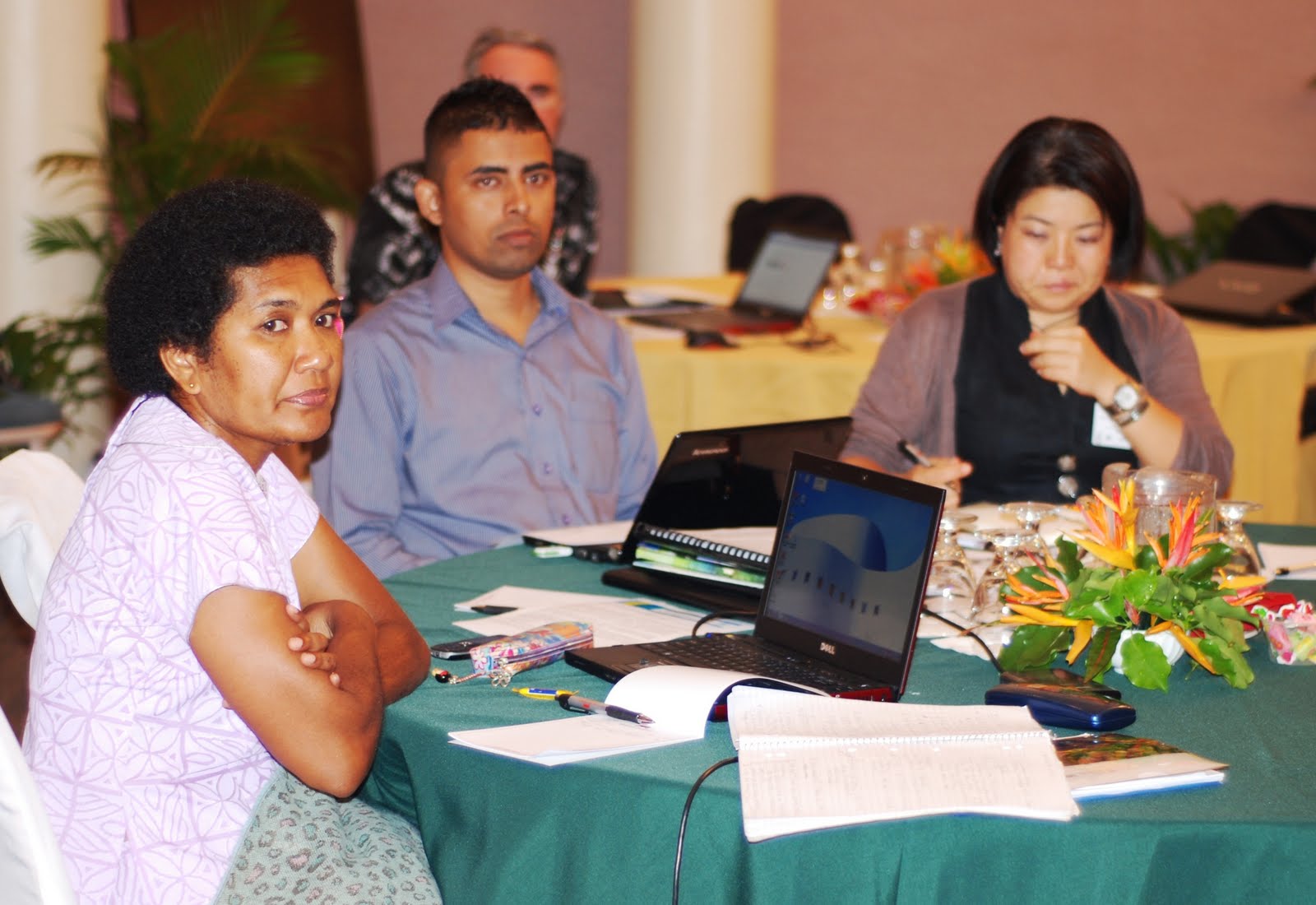
Participants at the Pacific Biodiversity meeting in Fiji
16 May Nadi Fiji - The implications of the Nagoya Protocol on the Pacific islands will be discussed during the 5 day meeting on Pacific biodiversity currently underway in Fiji.  This Protocol covers the access to genetic to resources and the fair and equitable sharing of benefits from their use.  The Nagoya Protocol is forecast to be in force by 2015.

It ensures that balanced access to genetic resources on the basis of prior informed consent and mutually agreed terms.  The Nagoya Protocol also ensures the fair and equitable sharing of benefits while taking into account the important role of traditional knowledge. 

As an example, and hypothetically, if a pharmaceutical company from Switzerland discovered a plant in the Solomon Islands which could lead to a drug which cured cancer, then that company would now be obliged to share the profits arising with the country.

“The adoption of this protocol will help ensure equity and fairness in the sharing of the profits made by the developed world from the biodiversity resources of the developing world in the small island developing states.  The next step is for the Pacific island countries and territories to sign up to the Protocol when they are ready and if they agree with it,” said Easter Galuvao, SPREP's Biodiversity Adviser.

The Global Environment Facility has offered financial support to assist with the early entry into force of this Protocol.


Notes:The meeting is held from 16 – 20 May at the Tanoa Hotel in Nadi, Fiji.
Participants are from the Cook Islands, Timor Leste, Federated States of Micronesia, Fiji, Kiribati, Marshall Islands, Nauru, Niue, Palau, Samoa, Solomon Islands, Tonga, Tuvalu, Vanuatu, Foundation of the Peoples of the South Pacific International (FSPI), IUCN - International Union for Conservation of Nature, United Nations Environment Programme (UNEP), WWF South Pacific Programme, University of the South Pacific.

The Pacific reflects on international biodiversity conference

Touasi Tiwok, Vanuatu,  CBD COP 10, Nagoya
Six months ago, the Pacific island region unified under a “One Pacific Voice” approach at an international biodiversity conference that brought together 18,000 people in Nagoya, Japan.  This week in Nadi these same Pacific island countries and partners have come together once again to review the performance of the Pacific and pave the way forward following the outcomes of the 10th Conference of the Parties to the Convention on Biological Diversity (CBD COP 10).


“At Nagoya, under the Pacific Voyage banner, we made a huge impact. Our voices were heard because we spoke with One Voice,” said Stuart Chape the Island Ecosystems Programme Manager of the Secretariat of the Pacific Regional Environment Programme (SPREP), as he opened the one week gathering.

“We were well coordinated, and we took a firm stand on issues that were important to our region. I am pleased to say that many of our development partners highly commended the Pacific island countries' performance, strong convictions and perseverance in Nagoya.  This success underscores the importance of working together as One Pacific speaking with One Voice - an approach that we should replicate at future Conferences of the Parties.”

Stuart Chape, SPREP

The agenda for the week will see discussions cover the Nagoya Protocol on Access and Benefit Sharing, the Strategic Plan of the Convention on Biological Diversity also known as the “Aichi Target”, funding opportunities, Protected Areas, Island Biodiversity and National Biodiversity Strategy Action Plans. 

This meeting is just one of a series of meetings to come for the region under the different outcomes of the CBD COP 10, to help the Pacific progress implementation to meet both national and the global biodiversity targets.  The next five days will provide time for the Pacific region to re-group, review their achievements at the international biodiversity meeting in Nagoya and work towards using the lessons learnt to progress implementation.

“It is not our intention to provide you with all the answers this week. However, it is our hope that this meeting will provide a platform for sharing information, ideas and experiences.  Although the agenda may seem ambitious I am confident that with your cooperation and active participation in the next five days, we can achieve a successful outcome - one that will provide us with an effective road map that will help Pacific countries progress towards meeting global, regional and national biodiversity targets.”

Notes:The meeting is held from 16 – 20 May at the Tanoa Hotel in Nadi, Fiji.
Participants are from the Cook Islands, Timor Leste, Federated States of Micronesia, Fiji, Kiribati, Marshall Islands, Nauru, Niue, Palau, Samoa, Solomon Islands, Tonga, Tuvalu, Vanuatu, Foundation of the Peoples of the South Pacific International (FSPI), IUCN - International Union for Conservation of Nature, United Nations Environment Programme (UNEP), WWF South Pacific Programme, University of the South Pacific.


Thursday, November 11, 2010

Pacific getting ready to meet new Biodiversity targets


18,000 people from around the world gathered recently in Nagoya, Japan at the 10th Conference of the Parties to the Convention on Biological Diversity (CBD COP10). 

14 countries in the Pacific are members of the CBD and the “Pacific voice” was well represented in Nagoya.

The Secretariat of the Pacific Regional Environment Programme (SPREP) worked in partnership with Non-Governmental Organisations (NGO’s) in the Pacific region to provide support and advice to the Pacific delegations at Nagoya.  

The meeting discussed how to address the dramatic loss of biodiversity currently occurring on earth. In fact one species is being lost every 38 minutes!

Delegates responded with a new commitment to “Live in Harmony with Nature”.

The conference agreed a number of outcomes, which have significance globally and for our Pacific region.

The Strategic Plan of the CBD or the “Aichi Target” was adopted at Nagoya. This is the new global plan to save the World’s biodiversity and includes a number of ambitious targets.

The “Aichi Target” includes a commitment to halve, and where feasible, bring close to zero the loss of natural habitats and also to protect 17% of terrestrial and inland water areas and 10% of marine areas. Also included are measures to control invasive species and to increase awareness of the values of biodiversity.

“We are pleased to welcome the Aichi Target as a guide for our region to work towards,” said David Sheppard, the Director of SPREP. 

“The targets are within our reach as the Pacific region has worked diligently to protect our unique biodiversity.  We can boast the Phoenix Islands Protected Area (PIPA) in Kiribati - the largest marine protected area on earth - now a World Heritage Site.  In our Pacific region we also have the Micronesia Challenge, a commitment by the Federated States of Micronesia, Marshall Islands, Palau, Guam and the Northern Marianas to conserve at least 30% of the near-shore marine resources and 20% of the terrestrial resources across Micronesia by 2020.  The “Aichi Target” will help us strengthen our conservation work across the Pacific.”

Another key outcome from the conference was the Nagoya Protocol covering the access to genetic resources and the fair and equitable sharing of benefits from their use.

As an example, and hypothetically, if a pharmaceutical company from Switzerland discovered a plant in the Solomon Islands which could lead to a drug which cured cancer, then that company would now be obliged to share the profits arising with the country.

This historic agreement is of great importance to the Pacific region.

It ensures that balanced access to genetic resources on the basis of prior informed consent and mutually agreed terms.  The Nagoya Protocol also ensures the fair and equitable sharing of benefits while taking into account the important role of traditional knowledge. 

It is expected the Nagoya Protocol will be in force by 2015. The Global Environment Facility has offered financial support to assist with the early entry into force of this Protocol.

“We have seen history in the making,” said Fiji’s Ambassador to Japan, H.E Mr Isikeli Mataitoga the Head of delegation for Fiji. He added:

“The adoption of the ABS protocol is a major step forward in bringing equity and fairness in the sharing of the profits made by the developed world from the biodiversity resources of the developing world, including the small island developing states.”

The current challenge for Pacific countries is to translate these key outcomes into national biodiversity strategies and to secure support from the international community for their implementation.

Many substantial commitments were made by countries at Nagoya, including a commitment by the Government of Japan of $2billion US to help developing countries protect their biodiversity

“For us in this region, it means working towards identifying opportunities and innovative ways to take these outcomes forward. We have agreed to the Aichi Target now we need to see how and where we can incorporate the different objectives into work we are doing at the national and regional level in the Pacific,” said Easter Galuvao, the Biodiversity Adviser of SPREP.

“In some cases we are on track with the targets, in other cases we need to work harder in a concerted and holistic manner as a region so that by 2020, the Pacific region can once again showcase to the world what we have accomplished as part of our contribution to save our biodiversity.”

These are just several of the many achievements of the biodiversity conference in Nagoya.

There were many more for the Pacific region.  Representation from the region ensured a strong Pacific presence was felt and heard as they were a vocal part of the negotiations. 

A communications campaign – “The Pacific Voyage” helped ensure Pacific visibility was high and our voices heard at the gathering of 18,000 participants with promotional materials and events which highlighted conservation successes in the Pacific as well as an event which promoted the different types of communication and awareness raising activities on nature conservation.

For SPREP the meeting has helped provide the guide for future work with the different member countries as the region strives to meet the Aichi Targets to help save global biodiversity.

Notes:
To read the full 2020 Headline Targets – Advance Unedited Text please visit Strategic Plan for Biodiversity, 2011 - 2020: http://www.cbd.int/nagoya/outcomes/

The 14 Pacific island parties to the CBD are Cook Islands, Federated States of Micronesia, Fiji, Kiribati, Marshall Islands, Niue, Nauru, Palau, Papua New Guinea, Samoa, Solomon Islands, Tonga Tuvalu, Vanuatu.

Our core partners who worked closely with us as part of the Pacific Voyage in Nagoya are The Secretariat of the Pacific Community, WWF South Pacific, Greenpeace Pacific, Wildlife Conservation Society, IUCN Oceania. 

Support was also provided from GLISPA the Global Island Partnership, Ms. Neva Collings on ABS and Article 8)j) and Ms. Mae Adams from TNC.

Thursday, October 28, 2010

Samoa to host reef protection meeting


Minister Faumuina Tiatia Liuga speaks during the high level segment of COP 10 in Nagoya Japan


The Pacific Voyage Media Team 28 October Nagoya Japan -

Samoa will host a high-level meeting to discuss coral reef protection and conservation.


This was announced by the Minister of Natural Resources and Environment (MNRE), Faumuina Tiatia Liuga in Nagoya, Japan.  He was speaking during the high-level segment of the 10th Meeting of the Conference of the Parties (COP10) to the Convention of Biological Diversity (CBD) at Century Hall, Nagoya Congress Centre.

The meeting is the 22nd General Meeting of the International Coral Reef Initiative (ICRI). It is scheduled from 8th to 15th November.  Samoa will co-chair the meeting with France during which participants are expected to update the ICRI plan of work for coral reef protection and conservation.

“Samoa is among a group of small islands within the largest of oceans rich in marine ecosystems that are critical to our survival,” the Minister told leaders at COP10, who worked late into the night to deliver their country statements.  “The Pacific Ocean, the beaches and its coral reefs are home to a number of marine mammals particularly the green, hawksbill and loggerhead turtles which are currently facing extinction.”

The meeting will focus on strengthening conservation programmes for such marine mammals.

“Samoa has in place a number of programmes and projects in the areas of biodiversity conservation and management, adaptation to climate change and promotion of renewable energy, community development in response to land degradation through country specific projects and regional programmes where biodiversity is an integral part,” the Minister said.

“We are continuing the partnerships with our development partners and partner organisations within the United Nations, International IGOs and NGOs, the World Bank and ADB to pursue these opportunities as they arise. On that note, we acknowledge all our development partners for their kind efforts and assistance.”

On biodiversity in general, Minister Faumuina said Samoa has taken active steps to address the loss of biodiversity.

“Because small islands are particularly vulnerable to species loss and extinction, we have to be creative ourselves, and develop innovative solutions so that shifts demonstrate that we are no longer dealing with biodiversity as business as usual,” he said.

“Hence I am pleased to inform that Samoa's pursuance of partnerships within the area of biological diversity, at the national level with communities, NGOs and private sector, regional level with fellow PIFS and SPREP members as well as international organizations, and at international level with our development partners, have enabled the progression of our programmes on Forest Conservation, Invasive Species Management, and Protected areas in marine and terrestrial locations.

“Closer relations with communities and farmers will be strengthened through national agro-ecosystem and agro-forestry projects under the GEF and government of Australia, where Samoa is at the forefront in promoting organic farming in the Pacific.”

The protection and conservation of mangrove ecosystems is an integral part of Samoa’s efforts. The mangroves’ resilience to storm surges and tidal waves provide protection against rising waves. Further, they provide natural breeding ground for marine life which people's livelihoods depend on.

“Samoa places great importance on synergistic implementation of programmes, where common objectives and activities exist,” he said.  “This provides for more effective service delivery to the public, a coherent approach to sustainable biological diversity management, reduce human and financial constraints, and contribute to achieving.”

The protection of biodiversity plays a major role in climate change adaptation, the meeting heard.

“Samoa acknowledged the commemoration of the International Year of Biological diversity this year with the promotion of Samoa to be carbon-neutral by the year 2020,” said Faumuina.

“Our national Samoa challenge to plant a million trees within our very small islands commenced in November 2009 for three years. The youth, (and children included) have already made some real contributions to this mission with plantings by young students of trees in our national reserves.
“Energy trees are also being assessed for further exploration of energy generating technologies. Ensuring these are properly designed and implemented to avoid adverse environment impacts on the biodiversity is of essence.

“That is because we believe that an investment in climate change mitigation and adaptation can also be a significant investment in biodiversity.”

Minister Faumuina urged world leaders to work together to reduce the rate of biodiversity loss.
"We should not be discouraged by the level of achievements being tabled, because within our small islands much progress has been made,” he said.

Tuesday, October 26, 2010

Money matters at Nagoya Biodiversity talks

The Pacific Voyage Media Team, 27 October Nagoya Japan -


A lengthy discussion  is guaranteed whenever and wherever dollars are involved.  That perhaps explains why there are difficulties in negotiating a protocol on Access and Benefit-Sharing (ABS) under the Convention of Biological Diversity (CBD), a leading delegate from the Pacific said.
An ABS protocol will facilitate the sharing of benefits between providers and users.

But the CEO of Samoa’s Ministry of Natural Resources and Environment, Taule’ale’ausumai La’avasa Malua said it’s a complicated issue because trade is involved.

“Even though there has not been an instrument under the CBD, there are other regimes which control trade,” he said.


“Once you move into the area of ABS, you are really talking about trade and it doesn’t just affect biodiversity, there are other issues.”

Pathogens add further complications.


“You need them to manufacture chemicals. So you are bringing in the health aspect which involves the World Health Organisation (WHO). That’s another big issue.”


If an ABS protocol is negotiated, it will be beneficial for all Pacific countries. In Samoa for example, a case in point is the mamala tree, said Taule’ale’a.


Several years ago, Samoa claimed sole rights to the mamala, a gene believed to fight AIDS and cancer which grows in trees found there. The claim was made under the 1992 international Convention on Biodiversity (CBD).


A 50-50 revenue-sharing deal was signed with the University of California, Berkeley. This is the university developing the potentially lucrative drug.


At the time the agreement was signed, then Minister of Trade and Commerce, Hans Joachim Keil told AFP: "What we are doing now is getting the rights so that when they need to proceed (with the drug) they will have to get it from Samoa.


"We have the rights to the research, and we -- only in Samoa -- can produce or harvest the mamala tree, so that they have to deal with us and the people in Samoa.”


Valerie Normand, an ABS Programme Officer for the Secretariat of the CBD, said it is cases such as the mamala which highlight the need for an ABS Protocol.


“Traditional knowledge has been held by indigenous communities for centuries and often this traditional knowledge provides important links to identifying which resources actually have particular properties which can be useful to human well being,” she said.

A Protocol on ABS will facilitate the sharing of benefits between providers and users.

“In exchange for access to genetic resources, users of these resources are meant to share the benefits arising from their use. And this is set out in the Convention for Biological Diversity.  Access to the genetic resources is subject to the prior informed consent of the provider country.


“A user must first seek consent of a country a resource is found in. A user can’t just go into a country, pick a plant and carry out research. They first have to obtain the approval of that country and they also need to negotiate mutually agreed terms and that agreement will include a number of requirements and conditions for access, and also most importantly the terms of benefit sharing.”


Benefits could be both monetary and non-monetary, she said.


Taule’ale’a said an ABS Protocol will also ensure a genetic resource is conserved.


“If a biodiversity plant or micro organism is used, there must be a benefit for the country where the plant comes from,” he said.


“But there are multiple agencies and requirements that cross paths on this issue. For example, there is the WTO (World Trade Organisation) with things like copyright and intellectual property rights.


“It’s a big issue within WTO. There is also the Court for things like that.


“But from a biodiversity perspective, it’s more or less similar except it has a business perspective.


“This is why there is so much fuss because the countries know that if an ABS Protocol is agreed upon, this is where the trade will be controlled from. Trade is money.”


Taule’ale’a added: “The countries will fight among each other to see who gets the benefits because it has to be fair and equitable. So companies will become involved and big countries will be involved. They will all want to have the majority of the say because they have bigger economies and better technology.”


For small countries like Samoa, an ABS Protocol will be most beneficial.


“There might be some traditional formulas from our taulasea (traditional healers) where we can make some money from. What’s most important is that there are some guidelines under which it can be controlled.”


The ABS negotiations are continuing. A decision is expected over the next few days, before the end of COP 10 in Nagoya.


Talking the Biodiversity Talk
Pathogen: To illustrate how the term is commonly used, see definition online at MedicineNet.com:
“An agent of disease. A disease producer. The term pathogen most commonly is used to refer to infectious organisms.  These include bacteria (such as staph), viruses (such as HIV), and fungi (such as yeast). Less commonly, pathogen refers to a noninfectious agent of disease such as a chemical.  The term pathogen was devised about 1880 and was compounded from patho- meaning disease + -gen indicating a producer. Hence, a disease producer.”


Samoa leads the way


L - R: MNRE CEO Taule’ale’ausumai La’avasa Malua, ACEO Faleafaga Tony Tipama’a, Easter Galuvao of SPREP, Dr Posa Skelton of SPREP and Editor of Samoa Observer, Mata’afa Keni Lesa.

“We don’t just sit around and wait for the world to make up its mind. We are trying our best to find help. If for some reason we cannot find help, we have to look to ourselves to help ourselves” – Taule’ale’ausumai La’avasa Malua
The Pacific Voyage Media Team, 27 October Nagoya Japan


Samoa is not waiting for the world to make up its mind over whether to protect the environment in the next ten, twenty or however many years.

That’s what the Minister of Natural Resources and Environment (MNRE), Faumuina Tiatia Liuga will tell the world when he addresses the 10th Meeting of the Conference of the Parties (COP 10) to the Convention of Biological Diversity (CBD) in Nagoya, Japan.

“Even though judging from the reports that the world has failed to meet the biodiversity targets, individual country progress varies,” Taule’ale’ausumai La’avasa Malua told the Pacific Voyage Media Team at the Nagoya Congress Centre.

“For us, we have started a programme to plan a million trees. Everyone is planting trees; even little kids are planting trees.”

Taule’ale’a is the Chief Executive Officer of MNRE. He is accompanying the Minister at the high level discussions involving hundreds of world leaders. Faleafaga Tony Tipama’a, an ACEO at MNRE, is the third member of the Samoan delegation.

Taule’ale’a said efforts to conserve the environment are being spearheaded by Samoa’s leaders.

“Even the Minister has planted 600 trees and I’ve also planted some trees,” said the CEO. “Students from one school, Vaiala Beach School, planted 360 trees at the national park. So everyone has been encouraged to play their part.”

The challenge for Samoa is land mass.

“So if legislation could open the opportunity for people to plant everywhere, that will be vital,” said Taule’ale’a. “Planting trees is important because it doesn’t only assist with mitigation of climate change, from the biodiversity perspective, it’s important we plant native trees and trees that are not invasive.

“So the Minister’s message is that we are not sitting there waiting for funds. We know there is a problem and we are moving to do something about it.

“That’s how our people work, that’s what we do. We don’t just sit around and wait for the world to make up its mind. We are trying our best to find help and if for some reason we cannot find help, we have to look to ourselves to help ourselves.

“We have to go back to the way we were before where we planted in the forest and work our land with our hands.”

Samoa believes it is important to promote and what’s been achieved so far.

“If you take protected areas for instance, we have a number of protected areas in the country, we have national parks,” said Taule’ale’a. “We have also worked to protect our coastal and marine environment. Fish is very important to us and they are under these protected areas and we have to ensure our protected area laws are firm to make sure they are fully protected.

“There are some cases where there are protected areas but you have to look at the administration to ensure there is enough money, know-how and human capacity for implementation.”

Money and the link to climate change are key factors in negotiations, said the CEO.

“Up until now, even though they are saying there is money for this and that programme, there doesn’t seem to be a lot.

“The only sure funding at this stage is from the Global Environment Facility which we have approached and are using for a number of our programmes. But there is not a lot of money, the most is probably about $5milion or $10million when these programmes should cost far beyond $10m, perhaps $50m or $1billion for one country.”

Samoa and other Pacific countries, however, should continue to persevere.

“Judging from the behaviour of the big countries, it seems they are not willing to increase funding. The European Union (EU) for example has said that they will not add anything further.
“EU’s focus in Samoa is on energy and water. Biodiversity in Samoa is mainly addressed through bilateral agreements with big countries such as with Japan where we have projects such as national parks and protected areas. We are also working with organisations such as the International Union for the Conservation of Nature (IUCN) for conservation areas, marine conservation and wetlands.”

One of the biggest challenges for biodiversity in Samoa is invasive species.

“An easy example is the myna bird,” said Taule’ale’a. “There are also the merrenia peltata grass (fue lautele) in the forest and the African snail.

“There are foreign species that have been introduced such as many different types of exotic flowers and different plants.

“We have to be careful that we do not allow species we introduce to solve existing problems to become problems in the future.

“An example of this is the myna bird, look at what’s happening now. We have to be very careful.”

Plans to develop energy sources must be made with conserving nature in mind, warned the CEO.

“There are plants that can be used for biomass classifications but we have to look at their invasiveness and how they can be controlled,” he said. 

“We have to look at how we can control these plants and that’s vital. We have to strike a balance. There were species that weren’t available before because the climate conditions weren’t favourable for their growth but now the weather has changed, some plant species are finding it more favourable than others.”

The issue of animals is an interesting one, the Samoan delegation noted.

“We have to tread carefully because what’s regarded by other countries as invasive are not necessarily invasive to us,” said Taule’ale’a. “For example, pigs are considered by other countries as invasive yet they are a key part of our diet so we have our own culling method. Besides the pigs do not go hungry in our country because we have a lot of coconuts to feed them.”

Biodiversity conservation can also be good for tourism, if its done right, said the CEO.

“We value our tourism for what it means to our economy,” said Taule’ale’a.  “There are many tourists who want to listen to birds, look at native plants and so forth, so it’s another tool to attract tourists to Samoa.”

Asked what he would tell Samoans about biodiversity, Taule’ale’a responded: “I want to stress that our environment is very important. Trees provide us with fresh air and it’s a sanctuary for our birdlife.

“Our environment deserves to be respected.  Our ancestors enjoyed a pristine environment, our present generation – eventhough with a lot of challenges – still enjoy the environment and our future generations deserve to enjoy the same environment.

“Our children should be able to enjoy the same environment our ancestors gave us. That’s why we should all work very hard to protect and conserve it.”

Pacific island youth urged to act now for biodiversity

“Pacific Island youths should have a vision to stand up and act on issues that affect island biodiversity.”
The comment was made by 22 year old Tongan voyager, Taviti Fisi’italia.
Tongan voyager, Taviti Fisi’italia
Mr Fisi’italia is among a strong international youth forum, Go 4 BioDiv, keen to have their voices heard at the 10th Conference of the Parties to the Convention on Biological Diversity in Nagoya.
At a side event marked by quizzes, fun games and presentations on their natural heritage, this group of young people from all over the world stated strongly that each unique biodiversity is interconnected.  They stated that we belong in a global community and that its time we start taking care of our natural heritage together.
 For Mr Fisi’italia, the issue of climate change destroying their island biodiversity is very important and real.
He said Tonga’s historical lapita pottery sites situated on every coastline in every island that make up Tonga may not exist anymore because of rising sea levels.
“This site not has archaeological value, it is also valuable biodiversity to the island communities,” he said adding that Pacific Islanders should have a vision to stand up and act, not to wait for others to tell us what to do.
Mr Fisi’italia is an environment coordinator for the Tongan Youth Congress for the outer islands.  Some of the environmental campaigns that he has been coordinating; are once every month they pick rubbishes along Tonga’s mainland coastlines and replant trees and mangroves to protect villages from threats caused by the sea.  He is also an active member of the 350.org.
The Youth Forum Go4BioDiv, which takes place parallel to CBD COP10, is aimed at raising awareness about the inter-dependence of biological and cultural diversity and inter-generational responsibilities for the conservation of our global treasures.  It offers young participants the opportunity to reflect on their experiences and exchange views on natural World Heritage sites as the emblematic and visible flag-ship of nature conservation and the effects climate change has on these sites.

Monday, October 25, 2010

We have the plan, but give us the dollars


The Pacific Voyage Media Team 26 October Nagoya Japan -

L - R Joe Aitaro (Palau) with Dr. Spencer Thomas of SIDS


Pacific island countries remain adamant a new Strategic Plan to protect the environment will be adopted on Friday at the end of the 10th Meeting of Conference of the Parties (COP10) to the Convention of Biological Diversity (CBD), in Nagoya.


Joe Aitaro, of Palau and one of the key negotiators for the Pacific, said progress was slow especially in the area of funding.


 “We’re here, we’re all very passionate and we still have hope that we’re going to reach an agreement on Friday,” he said.


“If not, word is that the Chairman will start an inter-government working group to work on those minor details and then present it back [to the parties].


“So there is still hope for us. But it will be a nice message when we go back to the world, especially in the year of Biodiversity that we came up with an agreement in Nagoya.”


Such an agreement will be crucial “to determine the future of life on earth.”


Mr Aitaro said funding is among the sensitive issues.


“The developing partners are saying they’re not quite sure as how, what type of capacity we need and how it’s being funded,” he said.


“So they’re coming up with a lot of ‘add-ons’ like we should have a plan for a plan to implement the plan.
“We’re saying, we already have a plan, just give us the funds and we’ll implement the plan. At the end of the day, it’s the will of the people with the dollars. If they want to make sure we achieve the concept and the goals of this convention, they should actually start funding these activities.”
Small island countries have been at the end of the line, Mr Aitaro said.


“We have been making a lot of impact on island biodiversity especially conservation management so it’s time they need to shift their paradigm thinking and look at successful countries in the Pacific.”       


Biodiversity progress in the Pacific has been slow. But Mr Aitaro said a lot of the progress depends on funding.


“For the Pacific, when it comes to the targets for protected areas in the marine, we want to see more ambitious targets set by our partners,” he said. “Globally it’s like only 1.7percent of the marine is conserved, yet we in the Pacific, when we look at it as a group in the Oceania, we have the most in terms of percentage that’s already in the MPA (Marine Protected Areas).

That’s a testament that we’re doing more with less and yet countries with the technology and resources cannot seem to mobilise [their resources] in the marine area.”


The discussions about access and benefit sharing are extremely important to the Pacific, said Mr Aitaro. 


“It’s time where countries need to make some sacrifices and compromise,” he said. “How long can this thing continue to drag? It’s been two years now, we’ve got to put a stop to it. It comes down to compliance and for the Pacific it’s our sovereign right, the ownership of these genetic resources.”


Mr Aitaro said Pacific delegates are happy with the progress on marine coastal issues.


“We’ve got good representation in there so it’s moving along but at a slow pace,” he said.
“The Pacific’s voice is being heard in these contact groups and it’s a good indication for me that we are well represented in our areas.”


Gaining financial support, however, is a priority.


In all the quarters, everyone is looking for somewhere to either get support from these private organisations or funding agencies to try and advance what’s happening,” he said.


“All indications coming in right now is that they are going to continue the level of funding for the CBD which to us is kind of ironic because now we’re talking about ABS and no funding.
“For us, there is a lot issues that depend on other countries and their interest.


“We want activities; we want the secretariat to fund activities on the ground that we have already started. We just need a little help to reach the visions of our countries.” 

Navigating the Pacific Voyage at Nagoya biodiversity talks

The Pacific Voyage Media Team 26 October 2010 Nagoya Japan -

L - R Dr. Posa Skelton, Faleaga Toni Tipama'a, Easter Galuvao, Bernadette Carreon


Easter Galuvao is SPREP’s Biodiversity Advisor and one of the navigators of the Pacific Voyage at the CBD COP 10. Having only commenced her new position at SPREP in April this year, she has jumped in at the deep end with the task of coordinating the Pacific island “voyage” to the 10th international conference of the Convention on Biological Diversity (CBD).

Preparations for the Conference have involved hosting a regional preparatory meeting (known as the Pre-COP), dissemination of key information, coordinating support from  – regional organisations, NGOs and key partners and developing a briefing paper for Pacific island countries to help identify key issues for the region.

“This regional approach has enabled us to amplify the Pacific voice at the COP – presenting statements on behalf of the Pacific Island parties getting our messages across,” said Ms Galuvao.

This is important for small island nations striving to be heard at a 15,000 person-strong international event.

The Pacific countries have been working hard to make sure that their position on issues such as access and benefit sharing (ABS), invasive species, biodiversity and climate change, the strategic action plan and financing are well articulated at the global negotiations.

Ms Galuvao says that even though she was well-versed on the CBD, getting to fully understand the current issues for the negotiations has been a somewhat daunting experience.

“This is the first time I have attended a Conference of Parties as a SPREP representative and the first thing you need to learn is to understand the roles of IGOs in the process and how to effectively provide support to the Pacific Island Parties,” she says. “There are formal working group meetings, contact group meetings and, of course the plenary sessions – you have to get your head around all these fit together first before you can do anything else”.

“Then, of course, you have the history,” she adds. “The draft working papers often refer to some decision made two or even three meetings ago. Those who have been attending the various meetings sometimes take it for granted that everyone else has this background.”

In actual fact, having to learn the process first hand and in a short space has possibly been an unexpected advantage for SPREP’s new Biodiversity Adviser and for many of the new Pacific delegates.

“Because I have had to learn myself, I have probably been more empathetic of our delegates’ needs,” she explains.

Certainly, Ms Galuvao’s input to the preparations is not over. As the second week of the negotiations unfolds, she continues to provide her assistance where needed, and is now in the process of facilitating a high level event with Pacific Environment Ministers during the week. As one of the navigators of the Pacific Voyage, Ms. Galuvao looks forward to as smooth a sail as possible on their Pacific Voyage to Nagoya and back to the Pacific.

“The work doesn’t stop here; we now have to look at actions to implement the outcomes of the Nagoya conference,” she said.   

Sunday, October 24, 2010

FSM seeks capacity building opportunities at Nagoya talks

The Pacific Voyage Media Team, 25 October 2010 Nagoya Japan

L - R - FSM delegation Willie Kostka, with Bernadette Carreon, Cytha Ehmes and Ricky Karl


The Federated States of Micronesia (FSM) depend on their natural resources, making their attendance at the 10th Conference of the Parties to the Convention on Biological Diversity (CBD COP 10) essential.

FSM comprises the four states – Yap, Chuuk, Pohnpei and Kosrae and contains over 1,000 plant species for which at least 200 are endemic species.  Its coral reefs, estimated at 14, 517km2 are home to nearly 1,000 species of fish and over 350 hard species of coral.

“While the nation may not have specific issues here at the Nagoya talks,” said FSM’s Ricky Carl, “it is working with aligning itself with organizations that will be of assistance in Capacity building.”

It is important for FSM to work towards achieving the goals of the Micronesian Challenge , an initiative  to effectively conserve at least 30% of their nearshore marine resources and 20% of their terrestrial resources by 2020.

Although each state is unique in making sure the initiative targets are met, it is well on its way of meeting 10 percent of its terrestrial targets and 15 percent marine targets.

He notes that FSM is well known for conserving protected areas but this effort is due to the customary laws and traditions to sustain biodiversity.

The issues of protected areas are also linked with invasive species and climate change which affect the small island nations such as FSM.

“We are learning that in order to protect and manage protected areas we have to deal with the invasive species issues and climate change,” Karl states.

Karl emphasizes that FSM also needs to do its part of ensuring that it complies with the CBD targets that focus on marine protected areas.

“Most of the community depends on the marine areas for livelihood and food,” he says.

As a small island nation, it too suffers from lack of financial and capacity resources to sustain its biodiversity programs making it essential to partner up with other Pacific island nations and organizations that will make their voice known.