Showing posts with label Aichi Targets. Show all posts

Monday, November 17, 2014

SPREP and CBD Strengthen Commitments to Biodiversity Conservation in the Pacific

15 November, 2014, Sydney, Australia - The signing of an agreement over the weekend between the Secretariat of the Pacific Regional Environment Programme (SPREP) and the Secretariat of the Convention on Biological Diversity (CBD) was a fitting culmination to the Pacific Islands Dialogue to prepare for Pacific input to the Promise of Sydney commitments being developed at the World Parks Congress.

The Memorandum of Understanding between the two organisations will ensure joint implementation of the Pacific region's Framework for Nature Conservation and Protected Areas in the Pacific Island Region 2014-2020, and the CBD Strategic Plan for Biological Diversity 2011-2020 and its Aichi Biodiversity Targets.
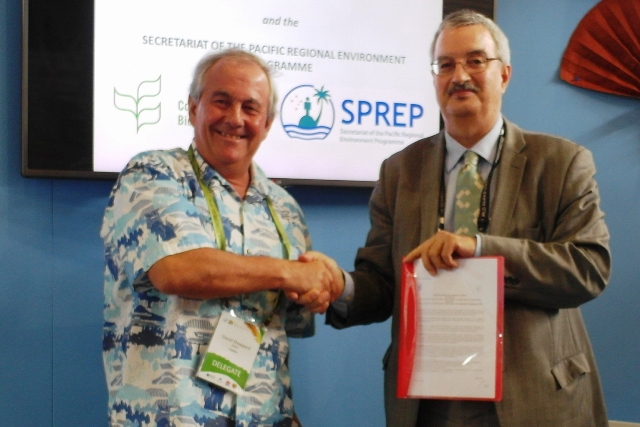
David Braulio SigningL - R Mr David Sheppard, SPREP and Dr. Braulio Ferreira de Souza Dias, CBD.
 The MoU was signed during a Pacific Dialogue session at the World Parks Congress
held at the Sydney Olympic Arena in Australia.

"Effectively, this means that under-resourced Pacific island countries, which have committed to meeting the Aichi Biodiversity Targets will benefit from our joint support in developing and implementing National Biodiversity Strategies and Action Plans while also establishing measurable goals that align with the Aichi Targets," said Mr David Sheppard, Director General of SPREP.

"This approach is also very much in line with what we are hearing from countries – the need for improved coordination between regional and international partners and more streamlined approaches to our reporting and monitoring."

"This partnership will bridge the gap between the global and local agenda as we are committed to doing more from regional perspective to help implement the global agenda," said Dr. Braulio Ferreira de Souza Dias, CBD Executive Secretary. "Specific areas of collaboration include scientific and technical cooperation, increased capacity in monitoring and financing."

Enhancing partnerships and cooperation between the European Overseas Territories and Small Island Developing States was also raised as a valuable opportunity.

Dr. Dias added that he and Mr. Sheppard "hoped to use the MOU also as a monitoring and assessment framework to help achieve the review of biodiversity strategies and action plans for all Parties, indigenous peoples and local communities, subnational governments and non-independent islands in the region, and ensure alignment of the global, regional, national and local agendas through the Aichi Biodiversity Targets".

"The recently launched Fourth Global Biodiversity Outlook suggests that we are not doing enough," he said. "We need to do monitoring if we are to know if our pledges are being implemented and effective."

SPREP and the CBD have had a close working relationship for several years. The renewed Memorandum of Agreement outlines key priority areas of work commitments between the two organisations.

Monday, October 6, 2014

Fiji calls for united global action to meet 2020 biodiversity targets


6 October 2014, Pyeongchang Korea, CBD COP12 - In 2010 a global strategic plan for biodiversity was agreed upon with targets, known as the Aichi Targets, to be met by 2020 to halt the rate of biodiversity loss.  In a newly launched Fourth Edition of the Global Biodiversity Outlook which provides a progress report on the state of global biodiversity today, governments were told that bold and innovative action is urgently required if the world is to meet these targets. 

Global Biodiversity Outlook 4 shows that three out of the 20 Aichi Targets are on track, with five of the targets needing much more effort and action.

In a statement to the floor at the 12th Conference of the Parties to the Convention on Biological Diversity today, Fiji stressed their concern for the lack of progress and called upon global united action.

"Fiji is indeed happy to note that there has been significant progress towards meeting some components of the majority of the Aichi Biodiversity Targets. The report states that some target components, such as conserving at least 17% of terrestrial and inland water areas, are on track to be met," stated Mr. Rahul Chand on behalf of the Government of Fiji.

"However Fiji remains concerned and worried that the progress seen may not be sufficient to achieve the target that has been set for 2020.  Despite Fiji taking several measures on a national level we may yet find it difficult to achieve the targets by 2020 however we remain optimistic and hopeful that we as a global family will do everything possible to stop the decline of our biodiversity."

Aichi Target 10 aims for the multiple anthropogenic pressures on coral reefs, and other vulnerable ecosystems impacted by climate change or ocean acidification are minimised so as to maintain their integrity and functioning by the year 2015.

According to the Global Biodiversity Outlook 4 Report, pressures from both land-based and marine activities continue to increase which makes it unrealistic to believe the target will be met by 2015 as agreed.  

The percentage of reefs rated as threatened increased by nearly 30% in the decade to 2007, the latest period assessed. Overfishing and destructive fishing methods are the most pervasive threats affecting around 55 percent of reefs.  One-quarter of reefs are affected by coastal development and pollution from land, including nutrients from farming and sewage.  Around one-tenth suffer from marine-based pollution.

This is just one of the summary of results of 20 Aichi Targets in all, featured in the Global Biodiversity Outlook 4 Report.

Mr. Rahul Chand, Fiji

"If we need to double our efforts and double our resource mobilisation then so be it," said Mr. Chand.

"The report notes dramatic increases in relevant activities, initiatives and necessary mechanisms put in place by Parties to halt biodiversity loss, yet extrapolations for a range of indicators suggest that based on current trends, pressures on biodiversity will continue to increase at least until 2020, and that the status of biodiversity will continue to decline.  That is not good news and we hope the key messages within the report provide a strong basis for our deliberations during the week."

The Strategic Plan for Biodiversity 2011-2020, and its 20 Aichi Biodiversity Targets, were agreed by the international community in 2010 in Nagoya, Japan, and have since been re-affirmed by the United Nations General Assembly and at the Rio + 20 summit in 2012.

The Global Biodiversity Outlook 4 Report was launched today  at the CBD COP 12, one year before the halfway point of the Strategic Plan for Biodiversity 2011 - 2020.

The CBD COP 12 is from 6 to17 October in Pyeongchang, Korea.  14 Pacific island countries are party to the Convention on Biological Diversity with Fiji, Kiribati, Marshall Islands, Palau, Solomon Islands, Tonga and Tuvalu currently in Korea attending the CBD COP12.  Soon to arrive are the Federated States of Micronesia, Samoa, Vanuatu and Papua New Guinea.

To download the full report please visit: www.cbd.int/gbo4
To read the full CBD Press release on the GBO 4:  http://www.cbd.int/doc/press/2014/pr-2014-10-06-gbo4-en.pdf

With wildlife populations cut in half, governments need to redouble efforts


WWF Media Release

Gland, Switzerland: A status report on biodiversity protection efforts shows that serious action is required to reduce pressures on natural systems and prevent continued decline of wildlife. The report was released on Monday at the opening meeting of the Convention of Biological Diversity in Pyeongchang, South Korea.

The report, the fourth edition of the Global Biodiversity Outlook, shows that some gains have been made toward meeting global targets for biodiversity protection. However, WWF is concerned that in most cases progress will not be sufficient unless urgent action is taken.  

“Governments must supercharge efforts to fulfill their promise to strengthen protections for nature by 2020,” said Susan Brown, WWF Director of Global Policy. “CBD, its parties and all stakeholders cannot afford to fail. This meeting must break down barriers to generate the willpower and resources to protect what little remains of our natural world." 

In 2010, parties to the Convention on Biological Diversity adopted a strategic plan and the Aichi targets, a set of 20 goals aimed at stemming species and habitat loss by 2020. According to today's report, a target to reduce human impacts on coral reefs and other ecosystems impacted by climate change or ocean acidification will not be met by its 2015 deadline.

“The natural essentials of life – the ocean, fresh water, forests – are generally valued at zero when governments do their national bookkeeping,” said Brown. “We flip from apathy to panic when those same natural systems are damaged and the true economic and social costs of biodiversity loss are revealed. We need to invest in our natural infrastructure before we suffer its irreversible loss.”

Last week, WWF's Living Planet Report 2014 found that global wildlife populations have declined, on average, by 52 per cent in the 40-year period since 1970. According to the WWF report, freshwater species have suffered losses almost double that of land and marine species. The majority of these declines are coming from tropical regions, with Latin America enduring the most dramatic drop.

According to the WWF report, the biggest recorded threats to biodiversity come from the combined impacts of habitat loss and degradation. Exploitation of wildlife and climate change are also significant threats.

“The Living Planet Report and the Global Biodiversity Outlook highlight the dramatic changes we have seen in wildlife, both on land and in water. As societies rapidly develop, it is critical to integrate biodiversity goals into national efforts to address poverty eradication, food security, water, health, and energy,” said Brown

At the current round of meetings in South Korea, WWF is calling for the expansion of protected areas that are critical to safeguard natural places and wildlife. Emphasis should be placed on coastal systems that are connected to local livelihoods and food security. WWF is also asking governments to focus on halting deforestation and other habitat loss.

"Governments continue to work against their own interests by providing tax breaks and subsidies for nature-busting programmes,” said Brown. “We need to update and deliver national plans, at least double international funding for nature, and put in place financial incentives for protecting the natural foundation to the societies we want to build.”

# # #
About WWF

WWF is one of the world’s largest and most respected independent conservation organizations, with over 5 million supporters and a global network active in over 100 countries. WWF's mission is to stop the degradation of the Earth's natural environment and to build a future in which humans live in harmony with nature, by conserving the world's biological diversity, ensuring that the use of renewable natural resources is sustainable, and promoting the reduction of pollution and wasteful consumption.  www.panda.org/news for latest news and media resources

Contacts
Leanne Burton, WWF-Korea
LBurton@wwfkorea.or.kr

David Hirsch, WWF-International
dhirsch@wwfint.org


---ENDS---

194 governments unite to save global biodiversity


6 October 2014, Pyeongchang Korea, CBDCOP12 - Traditional Korean drums set an exciting pace this morning at the opening of the 12th Conference of the Parties to the Convention on Biological Diversity, the fast pace symbolic of the urgent need to save global biodiversity. 

The World Wide Fund for Nature's Living Planet Report 2014 found that global wildlife populations have declined on average by 52% in the 40 year period since 1970. 

Over the next two weeks thousands of representatives of governments, non-governmental organisations, indigenous peoples, scientists and the private sector are gathered to accelerate the implementation of the Strategic Plan for Biodiversity 2011 - 2020 and its 20 Aichi Biodiversity Targets which are to be achieved by the end of 2020.

All of which contribute to halting biodiversity loss across the planet.

The collection of decisions to be taken at the CBD COP 12 is referred to as the Pyeongchang Road Map and is anticipated to include a resource mobilisation strategy expected to significantly increase the resources available for biodiversity conservation and sustainable use.


"There has been increased financial investment and policy action to protect biodiversity, yet, studies show that it will be difficult to reach the full set of the Aichi targets if we remain within the current trajectory, due to accumulated and increased pressures on the natural world," said UN Under-Secretary-General and UNEP Executive Director, Achim Steiner at the opening of the CBD COP 12.

"We need to do more, and do it fast, to protect the very fabric of the natural world."

At the opening today the Presidency of the Conference of the Parties was handed over from the Government of India to the Government of Korea.  The last Conference of the Parties to the CBD was hosted in Hyderabad, India in 2012.


The CBD COP 12 is from 6 to17 October in Pyeongchang, Korea.  14 Pacific island countries are party to the Convention on Biological Diversity with Fiji, Kiribati, Marshall Islands, Palau, Solomon Islands, Tonga and Tuvalu currently in Korea attending the CBD COP12.  Soon to arrive are the Federated States of Micronesia, Samoa, Vanuatu and Papua New Guinea.


To read the full CBD Secretariat press release on today's opening event please visit:  http://www.cbd.int/doc/press/2014/pr-2014-10-06-cop-12-en.pdf

Friday, August 10, 2012

The Pacific gear up for International Biodiversity Conference


10 August 2012, Rotorua, New Zealand - In 2010 a united voice from 14 Pacific Island Countries was heard at the world’s biggest biodiversity conference hosted by Japan. 

Held every two years, the Conference of the Parties to the Convention brings together over 190 countries, partners, NGO’s, media and others to address the commitments made under this Convention.

At the opening of the Pacific Regional Preparatory Meeting in Rotorua, New Zealand today, the challenge was laid for an even stronger voice from our region as the Pacific prepares for the next CBD COP 11 in India this year.

“Let us work together to make Pacific engagement and impact at COP11 even more successful than it was at COP10.  Together, as countries and supporting partners, we have the next few days to shape the basis for that engagement,” presented Mr. Stuart Chape, the Director of the Biodiversity and Ecosystem Management Division of SPREP.

The Secretariat of the Pacific Regional Environment Programme has coordinated the meeting which will identify and discuss the key priority issues and propose Pacific regional positions for COP11.

The preparations for this will draw upon lessons learnt from the CBD COP10 meeting in Japan.  It was there that the international community took stock of progress to meet the 2010 Targets to contain the loss of the world’s biodiversity.  This led to the “Aichi Targets” which are a set of ambitious global goals to save the worlds’ biodiversity by 2020.

The role of the Pacific island parties at the CBD COP11 is crucial, it ensures a voice at the international level will help trickle down to effective work conducted at the national level to save Pacific biodiversity.

“You as parties are the ones that take the decisions that guide the Convention of Biological Diversity on what needs to be done,” said Mr. David Duthie of the CBD Secretariat.

“We hope that this preparatory meeting will reaffirm and once again adopt a Pacific Voyage and One Pacific approach for COP 11 and replicate the success of our engagement at COP10.”

The Pacific Regional Preparatory Meeting for CBD COP 11 is held in Rotorua New Zealand from 10 – 13 August.  Participating countries are from Cook Islands, Fiji, Federated States of Micronesia, Kiribati, Nauru, New Zealand, Papua New Guinea, Samoa, Solomon Islands, Tonga and Vanuatu.  Also attending are NGO’s and other partners.

The meeting is funded by the European Union African Caribbean Pacific Multi-lateral Environment Agreement Capacity Building Project in partnership with the CBD Secretariat.