Showing posts with label SPREP. Show all posts

Monday, November 17, 2014

SPREP and CBD Strengthen Commitments to Biodiversity Conservation in the Pacific

15 November, 2014, Sydney, Australia - The signing of an agreement over the weekend between the Secretariat of the Pacific Regional Environment Programme (SPREP) and the Secretariat of the Convention on Biological Diversity (CBD) was a fitting culmination to the Pacific Islands Dialogue to prepare for Pacific input to the Promise of Sydney commitments being developed at the World Parks Congress.

The Memorandum of Understanding between the two organisations will ensure joint implementation of the Pacific region's Framework for Nature Conservation and Protected Areas in the Pacific Island Region 2014-2020, and the CBD Strategic Plan for Biological Diversity 2011-2020 and its Aichi Biodiversity Targets.
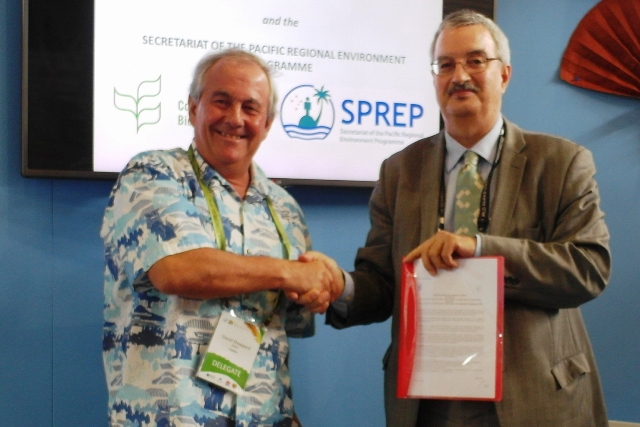
David Braulio SigningL - R Mr David Sheppard, SPREP and Dr. Braulio Ferreira de Souza Dias, CBD.
 The MoU was signed during a Pacific Dialogue session at the World Parks Congress
held at the Sydney Olympic Arena in Australia.

"Effectively, this means that under-resourced Pacific island countries, which have committed to meeting the Aichi Biodiversity Targets will benefit from our joint support in developing and implementing National Biodiversity Strategies and Action Plans while also establishing measurable goals that align with the Aichi Targets," said Mr David Sheppard, Director General of SPREP.

"This approach is also very much in line with what we are hearing from countries – the need for improved coordination between regional and international partners and more streamlined approaches to our reporting and monitoring."

"This partnership will bridge the gap between the global and local agenda as we are committed to doing more from regional perspective to help implement the global agenda," said Dr. Braulio Ferreira de Souza Dias, CBD Executive Secretary. "Specific areas of collaboration include scientific and technical cooperation, increased capacity in monitoring and financing."

Enhancing partnerships and cooperation between the European Overseas Territories and Small Island Developing States was also raised as a valuable opportunity.

Dr. Dias added that he and Mr. Sheppard "hoped to use the MOU also as a monitoring and assessment framework to help achieve the review of biodiversity strategies and action plans for all Parties, indigenous peoples and local communities, subnational governments and non-independent islands in the region, and ensure alignment of the global, regional, national and local agendas through the Aichi Biodiversity Targets".

"The recently launched Fourth Global Biodiversity Outlook suggests that we are not doing enough," he said. "We need to do monitoring if we are to know if our pledges are being implemented and effective."

SPREP and the CBD have had a close working relationship for several years. The renewed Memorandum of Agreement outlines key priority areas of work commitments between the two organisations.

Sunday, November 16, 2014

SPREP and CITES to strengthen measures to control trade in endangered species

L - R, Mr. David Sheppard SPREP and Mr John Scanlon CITES
The Secretariat of the Convention on International Trade in Endangered Species of Wild Fauna and Flora (CITES) and the Secretariat of the Pacific Regional Environment Programme (SPREP) have today signed a Memorandum of Understanding which will strengthen their common goal of the conservation and sustainable use of protected species of wild fauna and flora.

Signing the agreement in the margins of the World Parks Congress today, Mr David Sheppard, Director General of SPREP, reflected that currently only six Pacific island countries are Parties to CITES.

"This is of great concern for a region which is a biodiversity hotspot of global importance, but where wild species and their products are widely used and traded," he said.

These include sperm whale teeth, turtle shells, corals, shells, shark fins and birds, insects and reptiles.


All marine turtle species are listed as threatened under CITES - Image courtesy of Niue Tourism Office

"Without an agreed structural framework to work from, management of this type of trade is challenging, if not impossible," said Mr Sheppard. "The limited human and technical capacity in the region in this area is another major challenge. In signing this Memorandum of Understanding with the CITES Secretariat, we look forward to progressing in areas of technical capacity building to address trade in endangered and threatened species."

Mr John E. Scanlon, CITES Secretary General, said "SPREP is our strongest regional partner and we are confident that this agreement will ensure better coordination and cooperation, especially in supporting countries in the region build their capacity to meet their obligations under this convention."

One of the first tasks under the agreement will be to encourage other Pacific island countries to join CITES and to build synergies between CITES and other biodiversity-related MEAs in the region, in particular, the Convention on Biological Diversity (CBD), the Convention on Migratory Species (CMS) and the Ramsar Convention on Wetlands.

Mr Scanlon added that potential areas of collaboration were already evident as was seen in a recent joint preparatory meeting held prior to the Conference of Parties to the CBD, CMS and Ramsar. The joint preparatory meeting brought together those involved in implementing all four of the afore-mentioned conventions, setting the foundation for a more integrated approach to implementation and monitoring at national level.

CITES is a legally-binding treaty with 180 States Parties from six geographic regions (including Oceania), whose aim is to conserve biodiversity and contribute to its sustainable use by ensuring that no species of wild fauna or flora becomes or remains subject to unsustainable exploitation through international trade.

Tuesday, December 10, 2013

Turtles share message of hope for Pacific environment

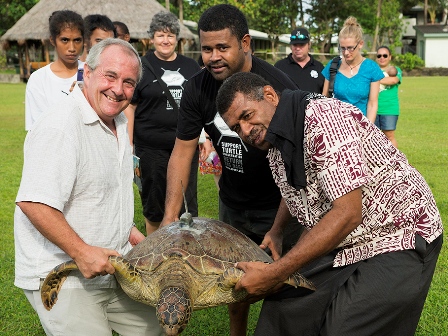
Turtle release 1

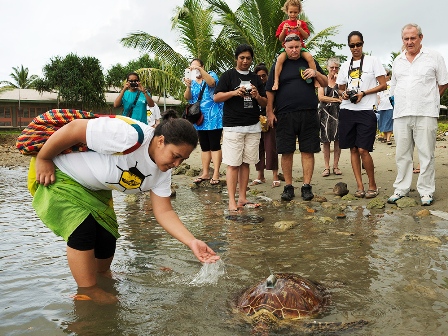
7 December 2013, Suva, Fiji -  In a symbolic marking of the end of the 9th Pacific Islands Conference on Nature Conservation and Protected Areas, five turtles were tagged in Suva on Saturday 7th December and released.
The ceremony took place at the lower campus of the University of the South Pacific, to commemorate the dispersal of the vision, spirit and messages of the Pacific region for the future of our environment.
"The release of these turtles is symbolic of our hopes that the key messages and spirit of the 9th Pacific Islands Conference on Nature Conservation and Protected Areas, will, like the turtles, travel far and traverse boundaries and be a point of focus for gathering multiple partner support for their implementation," said Mr. David Sheppard, the Director-General of the Secretariat of the Pacific Regional Environment Programme (SPREP).
Two of the five turtles were mounted with satellite tags and christened, Bulou ni Laucala after the conference and Adi Laumei Madiba in commemoration of the late Mauigoa Lui Bell and Nelson Mandela.

This special event of the conference was particularly significant, as it was an opportunity to again bid farewell to a great friend, Lui Bell, who was instrumental in the conservation of marine turtles across the Pacific islands region. Those gathered at the ceremony also paid tribute to another Pacific island champion for marine turtle conservation - George Petro, who passed away in late November.

Turtle release 2 copy

The tags were contributed by Mr. George Balazs of the National Oceanic and Atmospheric Administration (NOAA) Hawaii-based research programme as a tribute to Mauigoa Lui Bell and the Secretariat of the Pacific Regional Environment Programme region to further science based understanding of turtle migration for conservation.
"Satellite telemetry work has begun to unravel some of the mysteries associated with the travels of these ancient mariners. We have seen how the hawksbill, Lady Vini, navigated the EEZ's of seven Pacific island countries and territories covering nearly 4,500 kilometres in seven months," said Mr. David Sheppard.
"This information is crucial in helping us understand patterns of migration and consequently inform management decisions across countries and stakeholders including government agencies, communities and the public."
The voyages of Bulou ni Laucala and Adi Laumei Madiba through the Pacific islands will serve as a reminder of the need for collaboration and cooperation between SPREP members to ensure the survival of these ancient migratory animals in our waters.


Conserving Whales and Dolphins in the Pacific

MoU SPREP WHALES
David Sheppard - Director General, SPREP and Dr. Cara Miller - Programme Leader, Whale & Dolphin Conservation

6 December 2013, Suva Fiji - By Shahani Mala, journalism student of FNU:- An agreement has been forged to strengthen collaboration on the conservation of whales and dolphins in the Pacific region.

The MoU was signed in Suva on Thursday between the Secretariat of the Pacific Regional Environment Programme (SPREP) and the Whale and Dolphin Conservation.
"This agreement will strengthen our joint work on Whale and Dolphin Conservation," said Mr. Sheppard.

"This MoU formalises the ongoing cooperation and collaborative efforts we have undertaken to protect Whales and Dolphins, of which research plays a large role."
Programme Leader, Dr. Cara Miller said,

"We have excellent link to the universities so I am really hopeful that strong student participation can be part of the way going forward developing further developing projects we've already begun and have been working on."

The MoU lists key activities for collaboration which include promoting research and development of environmental modeling approaches to cetacean habitat protection and promoting the development and implementation of effective national cetacean management plans in the Pacific Island Countries and Territories.

The MoU was signed during the 9th Pacific Islands Conference on Nature Conservation and Protected Areas in Suva, Fiji.

Friday, October 19, 2012

Pacific delegates meet the new Head of Global Environment Facility


18 October 2012, CBD COP 11, Hyderabad India - Pacific delegates had a special breakfast meeting with the new CEO of the Global Environment Facility, Dr Naoko Ishii, at the 11th Conference of the Parties to the Convention on Biological Diversity.

Coordinated by the Secretariat of the Pacific Regional Environment Programme (SPREP) and the GEF Secretariat, the high level breakfast was an opportunity for the Pacific to meet with Dr Ishii and discuss funding issues.

“This years’ SPREP Ministerial Meeting also focused on environmental financing and the role of the GEF in particular.  Ministers noted strong appreciation for GEF funding in the region under the GEF- PAS – Pacific Alliance for Sustainability Programme.  This is the only regional GEF programme in the world and we consider this as a potential model of innovation for application elsewhere,” said Mr. David Sheppard, the Director-General of SPREP.
 
“It is critically important to continue to improve access by Pacific countries to GEF resources
It is positive that GEF 5 is allowing greater flexibility for access by small island states to GEF resources. We would like to see these initiatives continue and accelerate.  Dr Ishii - SPREP greatly looks forward to your leadership of GEF.  We appreciate the clear vision you have set out for the future of GEF and we stand to partner with you in these efforts.” 


 Dr Ishii has been at the helm of the GEF Secretariat for two months.  At the breakfast meeting she outlined her four key visions she had for the GEF, these being – the GEF must remain an innovator; must remain a champion of the Global Commons; must remain the partner of choice for environmental benefits and; must remain a catalyst in the evolving architecture of environmental finance.

“I see a lot of challenges, but also see a lot of opportunities too,” said Dr. Ishii.

“We have successes but need to continue these, we don’t have all the answers but we do have commitment for ‘on the ground’ achievements.”

A number of queries and concerns were raised by the Pacific delegates at the breakfast meeting during the question and answer session that was led by comments from the Minister for Local Government, Housing, Urban Development and Environment – Col. Samuela Saumatua.


“GEF must remain the partner of choice, but I ask you that we work together as partners in environment projects.  We work together against biodiversity loss and climate change, while you provide the funds, and we provide the tools and labour.  We work together in partnership, it’s the Pacific Way.”

The breakfast was attended by delegates from Cook Islands, Federated States of Micronesia, Fiji, Kiribati, Nauru and Samoa along with members from SPREP and the GEF Secretariat.

Tuesday, October 16, 2012

SPREP and UN relationship strengthened through Agreement


L - R David Sheppard SPREP, Achim Steiner UNEP

16 October, CBD COP 11, Hyderabad, India - Ties between the Secretariat of the Pacific Regional Environment Programme and the United Nations Environment Programme were rejuvenated today with the signing of a Memorandum of Understanding.

The 11th Conference of the Parties to the Convention on Biological Diversity was the backdrop for the event which brought together Pacific island countries and territories to commemorate.
The  also attended the event, meeting with the Executive Director of UNEP, Mr. Achim Steiner.

L - R Hon. Tufuga Gafoa, Associate. Minister of the Ministry of Natural Resources and Environment, Samoa, Achim Steiner UNEP
 
“This is a stepping up of what we have always called a very special relationship.  The Pacific region represents a very significant part of the planet and this relationship reaffirms and further develops our relationship between SPREP, the Pacific region and UNEP,” said Mr. Steiner.

“Small Island Developing States have in the United Nations, found one of the places where their voice is heard louder and clearer than in some of the other for a that we have for our geo-political meetings and I would like to commit our MoU that we have signed today, to strengthen that voice".


The last MoU signed between SPREP and UNEP took place in 2005, the new agreement is to cover the next five years.  It will help ensure increased cooperation in mutual areas of work and expertise.  Environment information will be exchanged and there will be an increased in capacity of Pacific islands to access and manage environment and climate change resources.
 
“We suffer major issues of isolation, biodiversity loss, major challenges and we must have good partners.  Since coming to SPREP we have had a reform process, focused on delivery to members, improved our systems and built better partnerships.  Partnerships are fundamental,” said Mr. Sheppard.

“We see UNEP as a partner of choice, this MoU is very important, and SPREP is committed to making this agreement in the future."


Present at the signing event today were delegates from the Cook Islands, FSM, Samoa, Tonga and Tuvalu with staff from SPREP and UNEP.

Thursday, October 11, 2012

Vava'u, Tonga Mangrove Survey successfully completed using GIS


Mangroves, Vava'u, Tonga

11 October, 2012 - The Vava'u Mangrove Survey which used Geographical Information Systems (GIS) found the mangroves of the island of Vava'u, Tonga in generally good condition.

This is according to Environmental Monitoring Analyst, Mr. Paul Anderson, of the Secretariat of the Pacific Regional Environment Programme (SPREP).

"Despite the usual impacts, of cutting, burning and waste the mangroves were in generally good condition, meaning the mangroves are resilient and healthy in most cases," he said.

Mangroves are vital to island ecosystems as they provide habitats for fish and crabs, protect coastlines and keep the water clean.  Mangroves remain a major component of ecosystem-based adaptation to climate change.

Anderson was the lead trainer for the one week Vava'u Mangrove Survey, a project by SPREP in partnership with Mangrove Ecosystems for Climate Change Adaptation and Livelihoods (MESCAL) and Ministry of Lands Environment Climate Change and Natural Resources, Tonga. (MLECCNR).

"The project maps and assesses the conditions of the mangroves of Vavau and trains local staff and volunteers on mangrove monitoring methodology and technology," Anderson said.

Field Team and trainer on the seaward edge of a mangrove stand, Vava'u, Tonga.
The technology used during the training included GIS, Geographical Positioning Systems (GPS) and the Pacific Mangrove Monitoring Manual produced by SPREP.   

Vava'u currently hosts 30% of Tonga’s mangroves, covering approximately 381 hectares of land.

Anderson said: "As part of the training and survey, we visited the majority of the sites,
exploring first-hand the condition of the mangroves, and assessing the impacts of human activity and nature on the mangroves."

During the surveys, the team discovered a small leaf mangrove associate species, which was only recently discovered in Tongatapu Pemphis acidula.

Pemphis acidula
 "This was a significant find as it expands the range of this species to a new island group," said Mr Anderson.

In addition to the small leaf mangrove associate, the team also came across the largest recorded red mangrove in the Tongan islands measuring at 20cm in diameter.

The team installed permanent monitoring points to asses and monitor the condition of mangroves over time.

Anderson acknowledged the contribution of his MLECCNR counterpart Sione Tukia Latu, the assistance of the MLECCNR Vava'u and Tongatapu personnel and the support of the Vava’u Environmental Protection Association (VEPA) in the field monitoring and GIS work.