Thursday, December 12, 2013

Traditional dance inspires youth

By Carolyn Kitione, a journalism student from USP
Pacific Nature Conference Closing Bulletin 2013, Suva Fiji - In an effort to engage more young people to get interested in environmental issues, the Foundation of the Peoples of the South Pacific International used culture and showcased traditional chants and dances.
About 50 people gathered at the Japan-Pacific ICT Auditorium at the University of the South Pacific for a special night to witness the power of traditional chants and dances organised by FSPI during the 9th Pacific Islands Conference on Nature Conservation and Protected Areas.
The production with the theme 'May it not be just a memory'  had lead performers from the Conservatorium of Music, a music and creative dance school in Suva, who dazzled the crowd with heart-pumping traditional dance and chants.
Programme coordinator Mr. George Nacewa said the whole production was targeted specifically at youths, who he said needed to acknowledge the messages in their oral histories and that it was relevant in the Pacific.
"Most of the people here tonight are young people and it's always good to portray culture.
"Even if it's generations old, it's still fresh and young people can relate to it," he said.
Backed by the Oceania Dance Group and singer Ilisavani Cava, the production exposed talents, portraying the contributions their ancestors had made to protect their land and the sacredness of their environment.

Carolyn Kitione is a member of the Media Team providing coverage of the 9th Pacific Islands Conference on Nature Conservation and Protected Areas from 2 to 6 December in Suva, Fiji. This is a partnership between the Fiji National University (FNU), University of the South Pacific (USP), SPREP and Pacific Islands News Association (PINA) whereby a team of 10 journalism students are mentored by senior reporters as they cover the conference. This activity is funded by the Pacific Assistance Media Scheme (PACMAS).

Your thoughts

What is your definition of a green and blue economy?

By Shahani Mala, journalism student at FNU

Nimoza Bethel, Vanuatu


“What I understand from green and blue econmy is that people we have to use resources that’s sustainable to the environment that keeps the atmosphere, the sea, and the terrestrial side to be more involment to keep it sustainable.”

Madhavi Colton


“It’s an economy that can grow to support human livelihood and culture while also sustain and work towards conservation.”

Aaron Buncle, SPREP


“Sustainable Development. Well, from an economics point of view I would say it’s properly considering the environment and living within the limits of a nature system.”

Durusolo Tavura, Fiji


 “What my understanding of green and blue economy is how you protect the environment. Most of the things that we use now especially things all generated by machinery so in the new modern day now they using all these battery systems that cause pollution.”

King Sam, Palau


“One way to look at generating sustainable revenue for management of protected areas, you can look at either a green economy which means you look at the terrestrial side to generate that revenue and possibly identify some sustainable financing measures through that way or can look at blue economy which in my opinion means you looking at fisheries and identifying if there’s any potential to actually generate revenue for management to that state where these things are applied. “

Premila Chandra, Fiji


 “From what I have learnt from this week long conference is that it’s to do with nature conservation, as simple as that. It’s to do with both our marine environment and our land environment, the biodiversity environment that we have in our country or any other country for that matter in the Pacific Island so green blue economy to my understanding is basically, what NGOS are trying to do in order to conserve our pristine environment.”

Shahani Mala is a member of the Media Team providing coverage of the 9th Pacific Islands Conference on Nature Conservation and Protected Areas from 2 to 6 December in Suva, Fiji. This is a partnership between the Fiji National University (FNU), University of the South Pacific (USP), SPREP and Pacific Islands News Association (PINA) whereby a team of 10 journalism students are mentored by senior reporters as they cover the conference. This activity is funded by the Pacific Assistance Media Scheme (PACMAS).

FSPI focuses on children and climate change

By Edward Tavanavanua, journalism student at USP

Pacific Nature Conference Closing Bulletin 2013, Suva Fiji - Working with grassroots communities on locally-appropriate climate change solutions is a priority focus area for the Foundation of the Peoples of the South Pacific International (FSPI).
The comment was made by FSPI's assistant researcher Mr. Amit Kumar, who was one of the rapporteurs at the weeklong 9th Pacific Island Conference on Nature Conservation and Protected Areas.
Mr. Kumar said one of their key initiatives was the Child-Centered Climate Change Adaptation and Disaster Risk Reduction (4CA) programme.
He said it was an approach that targeted activities that helped to reduce the vulnerability of children to the impacts of natural disasters and climate change.

"Children and young people are one of the largest groups at risk as a result of climate change," he said.

"Measures that target this group have the potential to reduce the impacts of climate change on a large scale."

Mr. Kumar said one of its aspects was explaining the impact of climate change and how to harness traditional knowledge to address the specific issues.
He emphasised the importance of bridging modern science and traditional knowledge.
Mr. Kumar said the 4CA programme recognised the sustainable potential of traditional knowledge in combatting the impacts of climate change.

FSPI coordinates the programme with its various partners in Papua New Guinea, Solomon Islands, Tonga, Kiribati, Tuvalu, and Fiji.

The 4CA model is a three-year-programme under the Humanitarian Partnership Agreement between AusAID and Plan International Australia.  

The programme is currently operational in four Asian and six Pacific countries. It ends in June next year.

Edward Tavanavanua is a member of the Media Team providing coverage of the 9th Pacific Islands Conference on Nature Conservation and Protected Areas from 2 to 6 December in Suva, Fiji. This is a partnership between the Fiji National University (FNU), University of the South Pacific (USP), SPREP and Pacific Islands News Association (PINA) whereby a team of 10 journalism students are mentored by senior reporters as they cover the conference. This activity is funded by the Pacific Assistance Media Scheme (PACMAS).

How Ms. Seiuli became a conservation convert


By Priya Chand, journalism student at USP

Pacific Nature Conference Closing Bulletin 2013, Suva Fiji - Ms. Taranaki Seiuli never understood the full value of nature conservation until she landed a job as an information management officer at the Secretariat of the Pacific Regional Environment Programme (SPREP).

Being around “nature conservation enthusiasts” for the past six months has opened her eyes to the need for such advocacy and support, said Ms. Seiuli.

“When you see these organisations being so committed to saving the environment, you automatically connect to it yourself,” she said.

“You feel glad that you are part of something that helps people and makes a difference in the world.”

Ms. Seiuli’s duties involve providing relevant information to SPREP and other organisations that request it.

Other than environment conservation, she said her greatest passion in life is her Christian Faith.

She said her faith preached care for creation. 

“Because of my faith, I believe that nature is God’s gift to us and I believe that we should take care of it,” she said.

“Thus, the person who cares for nature and its creatures is a wise person.”

Slipping back into the distant past, Ms. Seiuli recalled that whenever she heard a significant amount of funds was being allocated toward environment work, she never quite understood it.

“I always thought why so much money was being invested into it when it could be used to feed the homeless and spent on other things,” she said.

“Then when I started working at SPREP, I realised that these were people who were genuinely interested in making a change and that they were doing something real.”

She said she hoped more people, especially the youths who are the upcoming leaders, wake up and support the effort in whatever small way possible.

“I hope that through this conference, the same happens to those who are like I was,” said Ms. Seiuli.

Priya Chand is a member of the Media Team providing coverage of the 9th Pacific Islands Conference on Nature Conservation and Protected Areas from 2 to 6 December in Suva, Fiji. This is a partnership between the Fiji National University (FNU), University of the South Pacific (USP), SPREP and Pacific Islands News Association (PINA) whereby a team of 10 journalism students are mentored by senior reporters as they cover the conference. This activity is funded by the Pacific Assistance Media Scheme (PACMAS).

Making a difference with artificial birds


By Justine Mannan, journalism student at FNU

Pacific Nature Conference Closing Bulletin 2013, Suva Fiji - She's a bird lover and model-maker and during the 9th Pacific Conference on Nature Conservation and Protected Areas, Ms. Ann O'Brien, 53, was able to bring both those interests together. British national Ms. O'Brien is the wife of Mr. Mark O'Brien, the Senior Technical Adviser at BirdLife International in Suva.

She has been modelling from a young age. “The first thing I can remember was when I was about six, I was watching the football, the World Cup, and the mascot at the time was a lion and I was given some fabric and I sat and stitched a lion,” she recalls.

Now she is able to create lifelike birds, sharks, beetles and anteaters.

“It took me about three days (to make a bird), they are easy to make now that I know what I’m doing. I get better as I go along, the very first one that I made was a puppet and it took me three weeks but it took me a while to learn how to make model figures of birds,” she said.

Justine Mannan is a member of the Media Team providing coverage of the 9th Pacific Islands Conference on Nature Conservation and Protected Areas from 2 to 6 December in Suva, Fiji.  This is a partnership between the Fiji National University (FNU), University of the South Pacific (USP), SPREP and Pacific Islands News Association (PINA) whereby a team of 10 journalism students are mentored by senior reporters as they cover the conference.  This activity is funded by the Pacific Assistance Media Scheme (PACMAS).

From aircraft engineer to environment advocate


By Josephine Navula, journalism student at FNU

Pacific Nature Conference Closing Bulletin 2013, Suva Fiji - Love for his people and his homeland is what drives Premier Jackson Kiloe, the Premier of Solomon Islands’ Choiseul Province.

“I could see that we were facing problems of our forests being cut down and damaging the environment and nothing was done about it,” he said.

This was what caused him to put his hand up for the role.

“I had no background knowledge of the environment, but I took up the job because I had to fight for what was best for our environment and the people,” he said.

Premier Kiloe worked in Australia for seven years as an aircraft engineer before he returned home in 1997.

He said his Australian experience was relatively challenging because he was the only Solomon Islander where he worked.

“I was complimented on being so hard working, despite the challenges I faced,” he said.
 The father of five said he thrived on challenges though.

 “I faced these a lot while growing up,” he shared.

“My father was just a normal farmer, we didn’t have enough money but we didn’t see ourselves poor because we had everything around us that we could rely on.”
Premier Kiloe returned to the Solomon Islands when his father called him to return to look after his mother who was ill.

“I couldn’t do anything else even though I had elder siblings who could look after my mother, but I also missed everything about home,” he said.

Premier Kiloe said upon his return he realised the significant exploitation of their forests and he knew he had to do something to save it.

“The environment is home to everyone and everyone needs to be accountable for the actions they do to it,” he said.

Josephine Navula is a member of the Media Team providing coverage of the 9th Pacific Islands Conference on Nature Conservation and Protected Areas from 2 to 6 December in Suva, Fiji.  This is a partnership between the Fiji National University (FNU), University of the South Pacific (USP), SPREP and Pacific Islands News Association (PINA) whereby a team of 10 journalism students are mentored by senior reporters as they cover the conference.  This activity is funded by the Pacific Assistance Media Scheme (PACMAS). 

PYEN calls for change and support

By Edward Tavanavanua, Journalism student at USP

Pacific Nature Conference Closing Bulletin 2013, Suva Fiji - The Pacific Youth Environmental Network (PYEN) sought support and effective developments in local and regional environmental policies and initiatives at the 9th Pacific Islands Conference on Nature Conservation and Protected Areas in Suva, Fiji.

Journalism student at the National University of Samoa, Mr. Joshua Lafoai, 19, spoke on behalf of PYEN on the environmental areas they felt were the most in need of attention in the Pacific.

"We demand change; change is possible and we as youth call upon international policies to solve the issues in natural resources and ecosystems management, climate change, invasive species and biosecurity, and waste management," he said.

The network comprises the region's young environmentalists aged 15 - 25 years old who are actively involved in environment, sustainable development and youth projects in their own countries.

"We need to address these issues to ensure the sustainability of our natural resources and biodiversity," said Mr. Lafoai.

He also stressed the urgency of collective action against environmental degradation in the Pacific.

"Today everyone must take action," he said.

"As leaders of today and leaders of the future, we need to safeguard our generation and for future generations to come."

The PYEN produced a youth statement elaborating on these suggestions to Pacific Island governments and possible contributions in those four main environmental areas at their 6th PYEN Workshop held last week from 29 November - 1 December 2013, in Suva, Fiji.

A PYEN statement video on their concerns for today and visions for the future in the Pacific was launched at the conference.

Edward Tavanavanua is a member of the Media Team providing coverage of the 9th Pacific Islands Conference on Nature Conservation and Protected Areas from 2 to 6 December in Suva, Fiji.  This is a partnership between the Fiji National University (FNU), University of the South Pacific (USP), SPREP and Pacific Islands News Association (PINA) whereby a team of 10 journalism students are mentored by senior reporters as they cover the conference.  This activity is funded by the Pacific Assistance Media Scheme (PACMAS).

Tuesday, December 10, 2013

Turtles share message of hope for Pacific environment

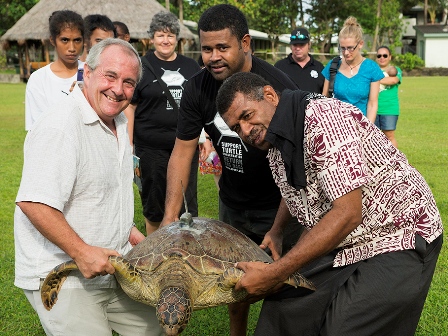
Turtle release 1

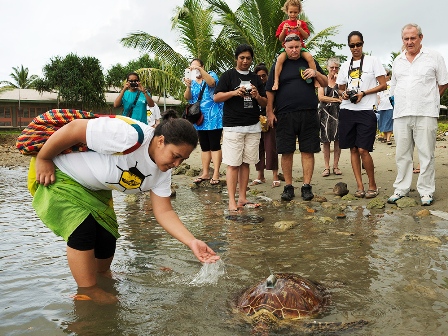
7 December 2013, Suva, Fiji -  In a symbolic marking of the end of the 9th Pacific Islands Conference on Nature Conservation and Protected Areas, five turtles were tagged in Suva on Saturday 7th December and released.
The ceremony took place at the lower campus of the University of the South Pacific, to commemorate the dispersal of the vision, spirit and messages of the Pacific region for the future of our environment.
"The release of these turtles is symbolic of our hopes that the key messages and spirit of the 9th Pacific Islands Conference on Nature Conservation and Protected Areas, will, like the turtles, travel far and traverse boundaries and be a point of focus for gathering multiple partner support for their implementation," said Mr. David Sheppard, the Director-General of the Secretariat of the Pacific Regional Environment Programme (SPREP).
Two of the five turtles were mounted with satellite tags and christened, Bulou ni Laucala after the conference and Adi Laumei Madiba in commemoration of the late Mauigoa Lui Bell and Nelson Mandela.

This special event of the conference was particularly significant, as it was an opportunity to again bid farewell to a great friend, Lui Bell, who was instrumental in the conservation of marine turtles across the Pacific islands region. Those gathered at the ceremony also paid tribute to another Pacific island champion for marine turtle conservation - George Petro, who passed away in late November.

Turtle release 2 copy

The tags were contributed by Mr. George Balazs of the National Oceanic and Atmospheric Administration (NOAA) Hawaii-based research programme as a tribute to Mauigoa Lui Bell and the Secretariat of the Pacific Regional Environment Programme region to further science based understanding of turtle migration for conservation.
"Satellite telemetry work has begun to unravel some of the mysteries associated with the travels of these ancient mariners. We have seen how the hawksbill, Lady Vini, navigated the EEZ's of seven Pacific island countries and territories covering nearly 4,500 kilometres in seven months," said Mr. David Sheppard.
"This information is crucial in helping us understand patterns of migration and consequently inform management decisions across countries and stakeholders including government agencies, communities and the public."
The voyages of Bulou ni Laucala and Adi Laumei Madiba through the Pacific islands will serve as a reminder of the need for collaboration and cooperation between SPREP members to ensure the survival of these ancient migratory animals in our waters.


9th Pacific Islands Conference on Nature Conservation and Protected Areas: A Success

David Sheppard copy

By Justine Mannan, journalism student of FNU
 
6 December 2013, Suva Fiji - The 9th Pacific Islands Conference on Nature Conservation and Protected Areas has come to a closing after five days of meetings, plenary sessions and workshops.
Mr. David Sheppard, the Director-General of the Secretariat of the Pacific Regional Environment Programme (SPREP), summed up the conference in one word – "outstanding."
"The participants are the ones who have made this event outstanding, through your active participation at all the events, through running such excellent side events, and by your active input to the Action Strategy and Declaration arising from this conference" Mr. Sheppard said.
Mr. Sheppard highlighted the issues facing the Pacific today such as loss of biodiversity, invasive species and climate change, together with the steps to help minimise the threats to our environment.
"The conference has underlined that better conservation and management of ecosystems is essential and that natural solutions must be a key front line response to climate and many of the other challenges facing our region."
"In the earlier conferences we looked to countries outside our region for our guidance and direction. Now this situation has turned as it is clear that the world is now looking at our region as a source of inspiration and guidance on nature conservation," Mr. Sheppard said.
Mr. Taholo Kami, the Regional Director Oceania, International Union for the Conservation of Nature (IUCN), acknowledged everyone who has contributed to the success of the conference, from representatives of the communities, faith based organisations, non-governmental organisations (NGO) and civil societies, Pacific island government representatives to the volunteers.
"Congratulations and thank you for hosting us with a great conference, thank you all for the celebration and the success" Mr Kami said.
Fiji is now the Chair of the Conference until the next event in 4 - 5 years time.
Justine Mannan is a member of the Media Team providing coverage of the 9th Pacific Islands Conference on Nature Conservation and Protected Areas from 2 to 6 December in Suva, Fiji. This is a partnership between the Fiji National University (FNU), University of the South Pacific (USP), SPREP and Pacific Islands News Association (PINA) whereby a team of 10 journalism students are mentored by senior reporters as they cover the conference. This activity is funded by the Pacific Assistance Media Scheme (PACMAS).