Monday, October 8, 2012

Small Island Developing States presents at CBD COP 11

8 October 2012, CBD COP 11, Hyderabad, India - Kiribati presented a statement on behalf of the Small Island Developing States at the opening plenary of the 11th Conference of the Parties to the Convention on Biological Diversity, calling for further resources and assistance to carry out the work under this biodiversity agreement.

The full statement (below) was presented by Ms. Nenenteiti Teariki-Ruatu, the Acting Director of Environment and Conservation Division, Ministry of Environment, Lands and Agriculture:

Kiribati, far right, presenting statement

"KIRIBATI is speaking on behalf of Small Islands Developing States

Madam President!

SIDS would like to thank and acknowledge the Government of India, Hyderabad Province, and the people of India for their warm welcome, generosity and excellent support to the delegates attending this eleventh meeting of the Conference of the Parties to the Convention on Biological Diversity (CBD COP11). 

We would also like to express our sincere gratitude and appreciation to the outgoing COP-10 President for his excellent leadership over the last two years. We commend on the excellent support provided by the Executive Secretary and staff of the Secretariat in ensuring that delegates get the meeting documents in a timely manner. We wish to extend our thanks to donor countries for their commitments in supporting the participation of Small Island Developing States at this important Conference.

Madam President,
SIDS continue to be at the forefront of biodiversity conservation which is demonstrated through leadership and commitment to protect, manage and sustainably use our fragile island ecosystems. We have made significant progress towards the Aichi Targets through a number of important interventions at all levels such as the Micronesian Challenge, the Phoenix Islands Protected Area, the Caribbean Challenge, the Western Indian Ocean Coastal Challenge and other major marine protected area initiatives in the SIDS.  

While notable progress has been achieved in the management of our biodiversity, much remains to be done; the management and eradication of invasive alien species, climate-change adaptation and mitigation activities, establishment and management of marine protected areas, capacity‑building, access to, and fair and equitable sharing of the benefits arising out of the utilization of genetic resources, and poverty alleviation, The impact of these threats has been especially grave on island biodiversity, which stands as a record of millions of years of evolution and has an inherent value to humankind.

The Aichi Targets cannot be reached without addressing the continued and ongoing loss of island biodiversity and the relationship to sustainable livelihoods. Political leadership and management action is needed to halt and reverse these trends.

Madam President,
The issue of limited human and financial capacities is particularly important for SIDS due to our small administrations, and continues to impede our efforts in effectively implementing the Biodiversity Strategic Plan 2010-2020 and achieving the Aichi Targets.

Capacity building and financial resources are crucial for the SIDS and are critical for developing our capability to effectively achieve the three objectives of the convention through implementation at the national level.

The SIDS call for new and additional, financial mechanisms and timely resource mobilization to effectively implement the Biodiversity Strategic Plan 2010-2020 and achieve the Aichi Targets. We would like to urge donors and development partners to provide adequate sustainable financial resources for the successful attainment of the CBD objectives.

Madam President,
The SIDS call on Parties to cooperate in the spirit of compromise to achieve a successful outcome for COP11 in Hyderabad.

We thank you for your kind attention."

More commitment needed to save world biodiversity


8 October 2012, CBD COP 11, Hyderabad, India - The 11th Conference of the Parties to the Convention on Biological Diversity opened today in Hyderabad, India, calling on parties to commit resources to meet the 2020 Biodiversity targets.  Parties to the Convention will be discussing the progress and challenges of implementing the Convention.

The Pacific region, rich in biodiversity nestled in Pacific Ocean which covers one-third of the Earth’s surface, has 14 Pacific island parties to the Convention that was signed by 150 government leaders at the 1992 Rio Earth Summit.  A plan of action is in place and will be discussed daily over the coming two weeks to ensure the Pacific concerns are raised and addressed among the thousands of delegates at the conference.

One of the key agenda items of common concern for the Pacific island region is the Strategic Plan for Biodiversity 2011 – 2020.  This is a 10-year framework for action, including on the 20 biodiversity targets set at the COP 10 in Nagoya Japan in 2010, have been established as the overall framework for biodiversity work in the United Nations system.  To successfully implement this plan, support is needed for the Pacific region to have the resources and capacity to achieve these targets.

In setting the scene for the coming two weeks of meetings, key speakers at the opening plenary are calling for more commitment of resources to meet the 2020 Biodiversity targets having failed to achieve a significant reduction of the current rate of biodiversity loss by 2010.

India’s Environment and Forest Minister, Ms. Jayanthi Natarajan, the President of the CBD COP 11, encouraged parties to view expenditure on biodiversity as an investment that will read benefits “for us and for our future generations”.

“Present global economic crises should not deter us but on the contrary, encourage us to invest more towards amelioration of natural capital for ensuring uninterrupted ecosystem services on which all life on earth depends.”

This was supported the Executive Secretary of the CBD, Mr. Braulio Ferreira de Souza Diaz said expenditure on biodiversity should not be seen as costs, but rather as investments that will pay back with “significant environmental, social and economic benefits for all our societies.”

“Yes, we are facing times of financial crises, but times of crisis are the best opportunities to make substantive changes in the way we do business.”

The CBD COP 11 ends 18 October, for more information on CBD COP 11 and the agenda items and documents, please visit: www.cbd.int

Pacific prepares plan of action at international biodiversity conference


7 October 2012, CBD COP 11, Hyderabad, India - Pacific delegates attending the 11th Conference of the Parties to the Convention on Biological Diversity met in Hyderabad, India to prepare for the coming two weeks of negotiations.

The Convention on Biological Diversity is dedicated to promoting sustainable development and was signed by 150 government leaders at the 1992 Rio Earth Summit.  It has three key objectives - conservation of biodiversity; sustainable use of biodiversity; and the fair and equitable sharing of the benefits arising from the use of genetic resources.

The Pacific meeting was to strategise the plan of action to address the agenda items of common interest, with a united approach, some of which include the Programme of Work on Island Biodiversity, Strategic Plan for Biodiversity, and Financial Mechanisms.

L - R Nenenteiti Teariki-Ruatu Kiribati, Ratita Bebe Kiribati, Sarah Tawaka Fiji
"It is crucial for Pacific Islands to really work together, considering the crucial items of pertinence to our islands and people within our region, which will be discussed in this global CBD level,” said Ms. Nenenteiti Teariki-Ruatu, the Acting Director of Environment and Conservation Division, Ministry of Environment, Lands and Agriculture.

“Teamwork, coordination, communication but above all, commitment; is key to effective participation of Pacific Island Country delegates, this will ensure that the global process will have positive impacts at our regional and national levels in the terms of meeting the three objectives of the CBD”

The Pacific delegates will also be working with the Small Island Developing States (SIDS) at the CBD COP 11, with preparation and input into a statement at the opening meeting to be read by Kiribati on behalf of the SIDS.

This meeting is the first of many to come.  The Pacific delegates will be meeting in the mornings on a regular basis during the conference, and also hope to meet with other Small Islands Developing States to prepare each day before joining the Asia Pacific morning briefings.

L - R Asterio Appi Nauru, Warwick Harris Marshall Islands, Stuart Chape SPREP, Easter Galuvao SPREP
The Secretariat of the Pacific Regional Environment Programme (SPREP) is providing technical, coordination and communications support at the CBD COP 11 to Pacific delegates.

Attending the first Pacific preparatory meeting were delegates from Fiji, Kiribati, Marshall Islands and Nauru, other Pacific delegates are still en route to India.

Saturday, October 6, 2012

Fiji calls for more support at Biosafety meeting


6 October 2012, CBD COP 11, Hyderabd, India - The Pacific region has engaged in the course of international meetings to help save World biodiversity with the curtain raiser event in Hyderabad, India; the sixth Meeting of the Parties to the Convention on Biological Diversity  which serves as the Meeting of the Parties to the Cartagena Protocol on Biodiversity.

The first days of discussion focused on the Cartagena Protocol on Biosafety which was adopted in January 2000 and entered into force in 2003, to address the safe transfer, handling and use of Living Modified Organisms that may have adverse effects on biodiversity taking into account human health, with a special focus on transboundary movements.

For Fiji, the key concerns raised at this meeting are; building the capacity of the Pacific to strengthen their work in bio-security and; additional financing opportunities outside of the Global Environment Facility.

Mrs. Taina Tagicakibau, the Permanent Secretary for the Fiji Ministry of Local Government, Urban Development, Housing and Environment at the MoP6.  Photo courtesy of ENB.
“For us it is about knowing more and learning about the latest happenings in the area of biotechnology as it can have its benefits, especially in the agricultural output,’ said Mrs. Taina Tagicakibau, the Permanent Secretary for the Fiji Ministry of Local Government, Urban Development, Housing and Environment.

“We need to manage how we proceed with this phase as there will need to be careful monitoring so any living modified organisms that enter Fiji does not pose a threat to the health of our Fiji community, or to our environment.  For this we need to build our capacity, it is a new subject for us.”

The Cartagena Protocol on Biosafety includes an advance informed agreement procedure for the imports of living modified organisms for intentional introduction into the environment.  It also incorporates the precautionary approach and mechanisms for risk assessment and risk management.

The Protocal established the Biosafety Clearing House to help facilitate the exchange of information and contains provisions on capacity building and financial resources, with special attention to developing countries and those without national regulatory systems.

The MoP-6 adopted 18 key decisions unanimously and called for giving utmost importance to the concerns and wishes of the indigenous and local people before a country decides on new genetically modified crops.

According to the Asian Age, all parties to the Cartagena Protocol on Biosafety accepted the need to conduct research on the socioeconomic impact of living modified organisms to fill the knowledge gaps and identify specific socioeconomic issues, including those with positive impacts.

“We hope the funds will come forward to help with building national capacity and would like the Global Environment Facility to consider allocating specific funds for Bio-security and Bio-safety alone, as they do for the Climate Change issue,” said Mrs. Tagicakibau.

“If managed properly and with responsible progress, this could have a positive impact on food production and poverty.  We should not fear this, if properly tested and if it undergoes proper regimes, this could help avoid world starvation and poverty, but it needs to be conducted properly, and for that we need funds, resources and support to build our capacity, both nationally and for that of our regional organisations which help support our work.”

Budgetary provisions to support member countries to implement the Cartagena Protocol on Biosafety were a key issue.  It was estimated that a core budget of $5,102 million is needed, apart from voluntary contributions and trust funds.

The conference agreed to appoint an ad hoc technical group that will go into the issues related to socioeconomic considerations of different countries and regions. The group consists of eight members from each of the five regions within the Meeting of the Parties.

There are 164 parties to the Cartagena Protocol on Biosafety, for which nine are Pacific Island Countries – Fiji, Kiribati, Marshall Islands, Nauru, Niue, Papua New Guinea, Samoa and Tonga are Pacific parties to the Protocol.  

India and Thailand have been endorsed as the members on the Compliance to Biosafety Committee by the Asia Pacific region, on the understanding that they will serve a one term of two years, whereby they will step down at the next Meeting of the Parties in two years time; and Fiji and Korea will then be considered for this committee.

The Sixth Meeting of the Parties was held from 1 to 5 October.

Meeting the Pacific delegates at CBD COP 11


5 October, 2012, CBD COP 11, Hyderabad, India - Mr. Siosiua Latu, delegate from Tonga with Mrs. Taina Tagicikibau, the Permanent Secretary for the Fiji Ministry of Local Government, Urban Development, Housing and Environment.  Mr. Latu of Tonga is attending his very first international biodiversity conference, having attended the 6th Meeting of the Parties to the Cartegena Protocol on Biosafety.

“I think for myself it’s a good experience, it is the first time for me to attend a high level meeting like the MoP 6 it is a good experience to listen and to learn from the other delegates.”

Pacific Voyage to Hyderabad, India, CBD COP 11


Exhibition booths at the CBD COP 11, the Pacific Voyage will join these in showcasing work.
 
6 October, 2012, CBD COP 11, Hyderabad, India -The Pacific Voyage is the name of the campaign in Hyderabad India to raise the profile of the Pacific region at the 11th Conference of the Parties.  A number of initiatives will take place under this campaign that will highlight the biodiversity successes in the region, to the international community.

A special event on the evening of October 18, titled The Pacific Voyage: Nature Protects if She is Protected, will be held.  This event will highlight and showcase the nature conservation work in the region as well as to launch the 9th Pacific Island Conference on Nature Conservation and Protected Areas to be held in Fiji, 2013.   Guest speakers for the event include the Minister for Local Government, Housing, Urban Development and Environment of Fiji – Col. Samuela Saumatua and Mr. David Sheppard the Director General of SPREP, amongst others.

The Pacific will have a special booth at the CEPA Fair (Communication, Education and Public Awareness) for which Pacific delegates have been asked to come with display materials and resources to exhibit and give way.

“We also have other activities under way as part of the Pacific Voyage,” said Nanette Woonton, SPREP’s Media and Public Relations Officer.

“During the preparatory meeting we prepared a communications plan with all the Pacific countries and realized that we ourselves are the best to share messages of our work in the region.  We have prepared tools to help our Pacific countries meet and network with other partners at this event to share the nature conservation work in the region.”

The Secretariat of the Pacific Regional Environment Programme (SPREP) have prepared pocket Compasses for the Pacific delegates with tips to help them through negotiations, a generic unified Pacific business card has been designed to share with others that detail the Pacific biodiversity blogsite, side event as well as special postcards about the 9th Pacific Island Conference on Nature Conservation and Protected Areas.  The unified business card and postcards will be shared amongst the Pacific delegates.


Save the Date!  Island Innovations!
 “The Pacific islands will also be represented during a special Island Bright Spots event coordinated by the Global Island Partnership (GLISPA), this will be an opportunity for all islands to come together and exchange their island innovations and successes with a roundtable discussion during the day and an Island Life Celebration in the evening.”

During this event SPREP will be signing a Memorandum of Understanding with the Secretariat of the Convention on Biological Diversity.

For more information on the Pacific voyage or the Island Innovations Event please email Ms. Nanette Woonton nanettew@sprep.org

CBD COP 11: Nature Protects if She is Protected


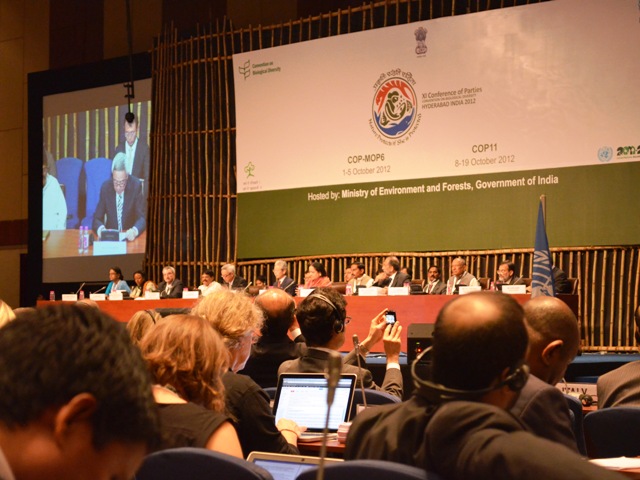
One of the venues at the CBD COP 11, Hyderabad, India
 
6 October, 2012, CBD COP 11, Hyderabad, India - The 11th Conference to the Parties to the Convention on Biological Diversity begins in Hyderabad, India next week.  The event is an important one for the Pacific region in efforts to conserve nature and halt biodiversity loss.

Signed by 150 government leaders at the 1992 Rio Earth Summit, the Convention on Biological Diversity is dedicated to promoting sustainable development. 

The Convention recognises that biological diversity is about more than plants, animals and micro organisms and their ecosystems – it is about people and our need for food security, medicines, fresh air and water, shelter, and a clean and healthy environment in which to live. (www.cbd.int)

Nature Protects if She is Protected - is the theme of the COP 11.  The Conference of the Parties is held every two years, bringing together all parties to the Convention as well as stakeholders and interested partners, to take stock on work done and to guide future work under the Convention.

“The In-depth Review of the Programme of Work on Island Biodiversity is one of the main agenda items that the Pacific will closely follow given the focus on island biodiversity,” said Ms. Easter Galuvao, the Biodiversity Adviser at the Secretariat of the Pacific Regional Environment Programme (SPREP),

“Continued emphasis on island biodiversity with adequate resources to support the implementation of the Programme of Work and the Aichi Targets would be one of the desired outcomes to be achieved at COP11.”

The Conference will be held from 8 to 19 October in Hyderabad, India.